
In order to work as intended, this site stores cookies on your device. Accepting improves our site and provides you with personalized service.
Click here to learn more
Click here to learn more
Our team at Scimcon is made up of a talented group of interesting individuals – and our newest recruit Ben Poynter certainly does not disappoint!
Ben joined our Scimcon team in July 2022 as an associate consultant, and has been working with the lab informatics specialists to get up to speed on all things Scimcon. We spoke to Ben about his experience so far, his interests, background, and what he hopes to achieve during his career as an informatics consultant.
So, I studied Biomedical Science at Sheffield Hallam University, which was a four-year course and allowed me to specialise in neuroscience. During my time at university, I created abstracts that were presented in neuroscience conferences in America, which was a great opportunity for me to present what I was working on. My final year dissertation was on bioinformatics in neuroscience, as I was always interested in the informatics side of biomedical science as well.
Once COVID hit, I moved into code work, and worked in specimen processing, and then as a supervisor for PerkinElmer who were undertaking some of the virus research. When things started to die down, I began working for a group called Test and Travel (not the infamous Track and Trace initiative, but a similar idea!). I started there as a lab manager, training new staff on lab protocols for COVID-19, and then a month into that I started working more on the LIMS side – which is where I ended up staying. I wrote the UAT scripts for 3 different companies, I performed validation on the systems, I would process change controls. I then moved to Acacium as LIMS lead there, so over the course of my career I’ve worked with a number of LIMS and bioinformatics systems, including LabWare 7, LIMS X, Labcentre, WinPath Enterprise, and Nautilus (ThermoFisher Scientific).
In the early stages, I would have to say it was when Jon and Dave led my first interview, and Jon asked me a question I hadn’t been asked in an interview setting before. He asked me ‘who is Ben Poynter?’. The first time I answered, I discussed my degree, my professional experience with LIMS and other informatics systems, and how that would apply within Scimcon’s specialism in lab informatics consultancy. Then he asked me again and I realised he was really asking what my hobbies were, and how I enjoyed spending my free time. Since starting at Scimcon, I’ve been introduced to the full team and everyone is happy to sit and talk about your life both inside and outside of work, which makes for a really pleasant environment to work in. Also, it seems as though everyone has been here for decades – some of the team have even been here since Scimcon’s inception back in 2000, which shows that people enjoy their time enough to stay here.
I’ve been given a really warm welcome by everyone on the team, and it’s really nice to see that everyone not only enjoys their time here, but actively engages with every project that’s brought in. It’s all hands on deck!
So, my main hobbies and interests outside of work are game design, as well as gaming in general. I run a YouTube account with friends, and we enjoy gaming together after work and then recording the gameplay and uploading to YouTube. We are also working on a tower defence game at the moment, with the aim to move into more open world games using some of the new engines that are available for game development.
In addition to gaming and development, I also enjoy 3D printing. I have a 3D printer which allows me to design my own pieces and print them. It’s a bit noisy, so I can’t always have it running depending on what meetings I have booked in!
Technology is a real interest of mine, and I’m really fortunate to have a role where my personal interests cross-over into my career. The language I use for game design is similar to what I work with at Scimcon, and the language skills I’ve developed give me a fresh perspective on some of the coding we use.
At the moment, I’m working on configuration for some of the LIMS systems I’ll be working with at customer sites, which I really enjoy as it gives me the chance to work with the code and see what I can bring to the table with it. Other projects include forms for Sample Manager (ThermoFisher Scientific), making it look more interesting, moving between systems, and improving overall user experience. It’s really interesting being able to get to grips with the systems and make suggestions as to where improvements can be made.
My first week mainly consisted of shadowing other Scimcon lab informatics consultants to get me up to speed on things. I have been working with the team on the UK-EACL project, which has been going really well, and it’s been great to get that 1-2-1 experience with different members of the team, and I feel like we have a real rapport with each other. I’ve been motoring through my training plan quite quickly, so I’m really looking forward to seeing the different roles and projects I’ll be working on.
I’d really like to get to grips with the project management side of things, and also love to get to grips with the configuration side as well. It’s important to me that I can be an all-round consultant, who’s capable at both managing projects and configuration. No two projects are the same at Scimcon, so having the capability to support clients with all their needs, to be placed with a client and save them time and money, is something I’m keen to work towards.
For more information about Scimcon and how our dedicated teams can support on your lab informatics or other IS projects, contact us today.
Scimcon Sponsors Oxford Global’s SmartLabs UK?SmartLabs UK is just days away from taking place in the capital of the country, and we’re proud to be sponsoring the 4th Annual SmartLabs Congress 2022 in London this year. Here, we explore what the two-day event will entail.
On the 8th and 9th September 2022, the Novotel London West will open its doors in welcoming leading experts of the lab informatics field to educate, inform and excite. From technical presentations to think-tank roundtable discussions, we had to join in.
Within a post-pandemic society, our reliance upon digital technology is greater than ever. In the field of life sciences, lab scientists are seeking better ways of consolidating and storing data. While paper-based labs are largely a thing of the past, many are filled with isolated information systems and nonstructured approaches, such as experimental workflows based at least partly in Excel.
Not only do such environments risk human error in transcription and duplication they restrict the organisations’ ability to search and mine data for critical insights.
Removing these disjointed workflows and dataflows are a key part of the wider digitalisation processes which are taking place throughout the lab space. It is no longer enough for laboratories to solely rely on LIMS, ELN, SDMS and instrument data systems.
It is important for the Scimcon team to stay ahead of the zeitgeist from customer-to-customer. Keeping up to date with current trends in lab informatics is at the heart of what we do.
What has this got to do with Oxford Global’s SmartLabs UK? The event will be split into two easy-to-follow streams, featuring all things lab informatics. If you’re unsure of what the latest innovations are, SmartLabs UK will provide the latest updates via over 50 cutting-edge presentations and a series of interactive discussions.
With virtual events becoming the norm in recent years, it is exciting for attendees to be given the opportunity of an in-person, collaborative experience. Day one of Oxford Global’s SmartLabs UK involves the exploration of monitoring and operational tools, and virtual reality tech demonstrations. Day two will delve into data standardisation and governance in lab informatics, and this is just the beginning. Some of the confirmed leading experts attending the event include the Genentech Director, Erik Bierwagen and Goldsmiths University professor, Larisa Soldatova.
If you think you’ve heard all of the latest informatics tools and technologies that are available, one of the benefits of attending SmartLabs UK will be the advice given on how to use these systems to leverage your data. After all, it is vital to understand how to put theory into practice. Taking advantage of the event’s opportunity for interaction, the 4th annual congress will provide an Event App. This will allow attendees to watch selected presentations on-demand, and contains extensive networking features. The benefits of using the app include; a dynamic agenda in which you will receive notifications of any changes to the day, a chance to the view the profiles of all speakers and organisations and a personalisation tool that allows you to organise and plan your schedule. There will also be an Event App prize draw for those participating in specified activities throughout the event.
As programme sponsor of Oxford Global’s SmartLabs UK, we are thrilled to assist in paving the way to laboratory digitalisation through automation, cutting-edge informatics tools and technologies. We believe that the digitisation of your laboratory projects should be done with the best advice and trusted expertise behind you. In turn, this is vital for the healthy reproduction of the life sciences industry.
Throughout the event, you can expect to receive this information in an engaging, illuminating way and through a variety of mediums. We will help to deliver think-tank discussions as well as trusted, face-to-face conversations with our team members who have direct lab experience. For those who prefer independent research and networking, we support the use of the Event App for all your lab informatics queries.
To organise a meeting with our team at the event, or to learn more about how Scimcon can support your digital lab transformation, contact us today. To learn more about lab informatics read more on our blogs via our website.
We’re hiring! Scimcon launches its first Graduate Consultant Scheme for scientific and technology graduates?Over the past year we have seen a vast increase in demand for quality individuals to lead and resource laboratory digital transformation projects.
This increased demand coupled with a desire to develop the next generation of world class consultants has resulted in Scimcon creating its first Graduate Consultant Scheme, for scientific and technology graduates.
Scimcon is actively partnering with universities and attending graduate recruitment fairs to attract and recruit the right candidates to join the scheme. The candidates will be trained in the multiple disciplines that Scimcon typically work, Project Leadership, Business Analysis, Solutions Architecture and Computer Systems Validation. Additionally, they will also get exposure to a domain that combines both science and technology. From the chemistry of materials science to biologics drug discovery, our teams work in a diverse range of scientific fields.
Scimcon will introduce the successful candidates to a career as a laboratory information systems consultant. Training will be provided in a variety of project settings in multiple industries and with various software vendors. The individuals will shadow our experienced consultants to build knowledge and gain an effective understanding of what it takes to provide insightful, pragmatic and highly valued consultancy services to laboratory-based organizations. Our graduate consultants will work on exciting projects for globally recognized industry names giving them the perfect opportunity to kick start their career. As our customers are based around the globe, there is also an exciting opportunity for successful candidates to travel and work on-site with customers in Europe, the US, and beyond.
As customer-facing consultants, our team demonstrate a particular set of qualities. They are dynamic, enthusiastic, driven, conscientious with an eye for detail. They have excellent relationship building skills, but above all they demonstrate integrity consistently. We are looking for individuals that exhibit these same qualities.
If you are graduating in 2022 with a scientific or computer/technology related degree/masters/PhD and you are looking for an exciting career in informatics consultancy, please get in touch with Scimcon’s Head of Operation, David Sanders at dsanders@scimcon.com
Scimcon sponsors SmartLab Exchange and identifies priority themes for 2022 lab informatics?
With the March congress on the horizon, we take a look at some of the trends within the industry over the last year, and what to expect from the March event.
It’s not a surprise that, with the impact of the pandemic, the importance of digitisation has been heavily reinforced. In early 2020, we reflected on Scimcon’s experience of providing remote support to clients and some of the changes we witnessed as a result of the COVID-19 pandemic, and now almost two years on, we’re seeing a new way of working across labs and organisations.
With digital transformation hot on the global agenda, what’s next for analytical and clinical laboratories? What will the lab of the future look like? Lab of the Future’s March congress aims to answer that question.
With a selection of activities scheduled across the 2-day event, there is no shortage of opportunity for attendees to get involved – whether that’s in-person in the Boston, MA event, or from the comfort of their own workspace via virtual attendance.
The agenda features a range of roundtables and presentations, including plenary sessions, as well as more focussed discussions on specific topics, from the digital lab to the connected innovation lab. The tradeshow will also feature plenty of networking session throughout, allowing individuals to form valuable new connections and learn more about some of the key players and innovation across the industry.
The event also welcomes a wide of speakers presenting and hosting discussions during the 2-day period. With confirmed speakers from GSK, Merck, Pfizer, Boehringer Ingelheim, and Astrazeneca, amongst many others, it’s guaranteed to be an event filled with interesting discussions from some of the organisations that have become household names over the last 24 months.
In addition to discussions, the event is also hosting technology showcases, for leading solution providers to demonstrate some of the latest and most disruptive innovation that they’ve been perfecting behind the scenes. Focussed work tracks also allow attendees to take a more in-depth look at some of the latest technologies and trends in 4 key areas – lab automation, digitalisation, connectivity, and innovation.
Lab of the Future is an insightful event, and one that we look forward to as well as sponsor each year. The in-person aspect of the event will make for a refreshing change following the pandemic restrictions experienced worldwide, but the additional virtual element of the tradeshow means that users around the globe can participate and get involved, regardless of restrictions and concerns surrounding COVID-19 and travel.
However, in addition to the event, the lab of the future is a concept. Our team at Scimcon has over 20 years of experience in laboratory informatics, and with many of our team members having direct lab experience, we can help you get your digitisation and laboratory informatics project off the ground, whilst understanding the questions and concerns faced by scientists every day.

Scimcon, the decades-strong leader in scientific informatics for the lab, has announced in 2021 that it has made a company-wide commitment to support Blood Cancer UK. After years of ad hoc charitable donations, Scimcon has decided that from 2021 the company will support one charity, and going forward all its charitable donations will be related to fundraising in the cause of Blood Cancer UK.
Geoff Parker, our co-founder explains: “When we really thought about it, it makes sense to ensure that the entire company aligns behind one cause. A company’s charitable contributions are not insignificant over time, and that’s why we are determined that every dollar and penny of our charitable contributions going forward will all be donated to our charity of choice. This means that every member of staff in Scimcon understands that from this year, without fail, we will all support this charity.”
Blood Cancer UK is a community dedicated to beating blood cancer. They do this by funding research and supporting those affected. Since 1960, the charity has invested over £500 million in blood cancer research, transforming treatments and saving lives. Right now, the Blood Cancer UK community is funding 167 researchers and staff across the UK who are searching for the next breakthrough. The day we will beat blood cancer is now in sight, and the charity’s researchers are determined to finish the job.
The charity also campaigns for change, helping to make sure that people get the healthcare they deserve, and that new treatments that come from research breakthroughs are available on the NHS.
Geoff adds, “As scientists working with scientific companies, Scimcon is committed to investment in science – it is our lifeblood. The fact that Blood Cancer UK is funding lifesaving research appeals to our ethos as a business. You only have to read the most recent annual report from the charity to learn what their money is spent on: Survival rates have improved dramatically over the last few decades, and even over the last 10 years we have seen blood cancer survival rates increase faster than survival rates for other cancers.”
In 2020, investing in life-saving research remained at the heart of their work, with the announcement of £6.5 million of new research funding. This money was spread across 15 projects, supporting the work of 169 researchers at 30 research institutions. This included a series of projects focused on acute myeloid leukaemia, which has one of the poorest outcomes. The researchers will identify better treatment targets, test the potential for repurposing existing drugs, and develop new ways to predict which patients will respond to current treatments.
They are also funding research that will look at how a key gene drives cancer development in children with Down’s Syndrome. Two Lymphoma teams will look at the role of the Epstein Barr Virus in the development of lymphomas, focusing on lymphomas and other blood cancers that develop as a result of treatment in people who have had an organ transplant. Blood Cancer UK also funded new research in myeloma, that will look at how myeloma develops and how patients respond to immunotherapies.
Thanks to previously funded research, there were 117 papers published in scientific journals during 2019/20. These papers covered a wide range of science, from laboratory research to clinical trials, and covered the full range of blood cancers. Geoff explains “In our small way, Scimcon might be working with companies who contribute to this mammoth effort. Our customers in laboratories worldwide are part of this great community, and Scimcon believes that money is only part of the effort to save lives. We are proud to be associated with Blood Cancer UK as our charity of choice.”
To learn more about the life-saving work Blood Cancer UK does, visit www.bloodcancer.org.uk
Scimcon goes carbon neutral?
With 20 years’ experience in the Biotech and Life Sciences industry, Micah Rimer’s success has been primarily due to his ability to read organisations, frame the problems and identify the best path to bring people together to achieve the desired goals. During Micah’s time working in Biotech and at big pharma he has successfully deployed consultancy groups within lab informatics and clinical projects.
Scimcon has supported Micah and his teams extensively on high profile projects in big pharma and Biotech. In this blog, Micah draws on his valuable experience to provide insight and tips on how to best to engage and work with consultancy groups.
Deciding on the right Informatics Consultant for your pharma or Biotech company is not a simple task, despite the various vendors available. Informatics in the Life Sciences industry covers a wide scope, so it is unlikely you will find an appropriate consultant through Google’s search algorithms. To find the best fit, you should consider what the key priorities are for your engagement, find a partner that you can trust and work well with and one that can bring a unique perspective to your collaboration.
Starting out with the key skills and contributions that are needed, as in any selection process, is the first step in identifying the right Informatics Consultant.
While technology is constantly advancing, I would encourage you to think hard if the tech skills are really the most important aspect for a successful collaboration. From my experience, while an understanding of the underlying technology and what it is capable of is important (be that LIMS, ELN, eCOA, eDiaries, PV software etc), what is of more importance is someone who can both communicate and partner with the organisation. A successful computerised system consists not just of the software, but also the people that will use it and the processes they will follow. All of those components must be balanced for a successful implementation, so while the technology piece may feel like the most obvious area to address, do not underestimate the work with the people and processes.
For example, there was a point in my career where I was asked to implement a Pharmacovigilance (PV) signal detection system for an organisation I was employed by. This had been a critical gap in the organisation for a long period of time, and there were several options on how to proceed, but no easily defined right answer. We could look to either evaluate and buy something off the shelf, hire a company to build a custom-designed tool, or alternately we could try to finalise a prototype that a programmer in the department had been playing around with for a while. (His tool had nice features, but still some technical gaps and no clear path forward to make it robust enough to use in such a highly regulated environment). In looking for external help, some may have favoured looking to recruit Informatics Consultants with a background in Pharmacovigilance, or perhaps with the technology skills to leverage the drug safety system platform. But in choosing Scimcon, I went with the partner I trusted to help evaluate the options and lead a successful implementation in that particular organisation. A fantastic off-the-shelf tool would never have been a success if people did not want to use it because they preferred the home grown highly customized (but invalidated) prototype.
With Scimcon on board, we were able to evaluate the pharma and drug safety landscape and determined that there could be a good path forward with the prototype that had already been developed. We were able to establish an effective team, drawing upon the Pharmacovigilance expertise in the department to address business process and usage questions. The programmer who built the prototype had the vision for how the software should work and what needed to be done from a technical perspective. Scimcon was able provide the knowledge and experience of how to move a prototype to a production system and validate a custom-defined tool that had been built by a programmer who does not have expertise in documentation. The output was widely recognised as a huge success.
It is important to keep in mind what gaps you are trying to close and what capabilities are needed to fill them: – Maybe you need the knowhow to get a project completed in a challenging environment; the technical skills to do the programming; the expertise with documentation; or you need to access people who have exceptional attention to detail to make sure a system is appropriately qualified and works as intended.
Whatever your challenge, you should ensure that the skillsets available from your informatics consultancy match the challenges you are facing.
As with many relationships, the more time you work together, the more trust you build up. This just proves that the importance of having established relationships and ways of working cannot be understated. No one is perfect, but the devil you know may indeed be a better fit than someone new to you. Always think about building up relationships for the future; it is a small world.
With this in mind, when looking for life science Informatics Consultants to partner with, one key consideration is to determine how they will be able to deal with adversity. What are they prepared to do if they see that a project is starting to go sideways? When speaking with them, ask them about projects that did not go according to plan or did not work out, and how did they manage that situation? What did they learn from that? Do they do anything differently from those lessons learned? Consultants, and Informatics Consultants especially, have all been thrown into projects where the requirements and expectations were not appropriately set in the beginning, which lead to problems later. Good consultants always learn from these situations and avoid repeating the mistakes that led them down that path.
Another key consideration for the interviewing and recruitment process is the quality of the questions the consultants ask and how well they listen.
Before you speak with them, think about what questions you would ask if you were in their shoes, and not having access to all the internal information you have: – Do they ask the right questions? Maybe they ask some questions you had not thought of? And how well are they able to play back what you have told them?
Often sales or account managers are very focused on telling you how easy it is for their teams to deliver, and how they will be able to deliver no matter what restrictions and conditions you add into the situation. Are there any conditions of the setup that would prevent the consultants from accepting the assignment? If there is nothing you can state that would cause them to be concerned, then maybe they are too good to be true! Look for their understanding that implementing systems is not usually a walk in the park. A truthful consultant is extraordinarily valuable.
Of course, it is always good to check the references as well. Does the life science informatics consultant have customers that have worked with them over a long period of time at different companies?
Bringing in consultants is typically not so easy, so numerous long-term engagements at different stops can itself also be a sign of delivering quality.
You should also look for feedback on the work the consultants delivered. There is a huge business out there for the larger agencies which spend time and resources selling at the executive level, but then use more junior resources to do the work. Having senior people presenting and being able to provide a concise message is important, but by and large you typically want to find people who are getting the work done. You must never lose sight of the goals to deliver projects on time and the overall drive for results.
Consider all of these aspects and listen to your instincts. Typically, these are not small or unimportant investments in the first place. Taking time to ensure you have the right fit is important. At the end of the day, you need to feel comfortable and confident that the people you choose can be counted on to deliver for you.
To me, one of the most valuable skills I look for with Informatics Consultants is the ability to bring a unique perspective. In a management training course I once took, the advisor summed it up this way: “Look, you are all smart people. If you come to a situation where you do not see a solution, it is probably because there is not just one solution. When you arrive at a situation like that you will have to find some way to balance and continually adjust, as there is likely no one right answer.” When I am bringing people in to support me on projects, I am looking for that ability to connect the dots and leverage previous experiences to help find the best solution.
One of the valuable parts of working as a consultant is that you get to see a variety of companies, all with different setups. While some people find that lifestyle stressful or challenging, there is an inherent value in being exposed to so many alternative organisational environments. If you can synthesize new information and learn rapidly, all these experiences add up to quite some knowledge. The more you can see things repeated with modified parameters, the easier you can find what works and what does not work, which is why we look to simulations to find some solutions. Informatics Consultants that have worked in different Biotech and big pharma settings with a wide exposure to different projects can help bring that knowledge to your organisation.
Finding consultants who have worked in various parts of life sciences or in other fields can also help to provide a more well-rounded view. At times, that enables seeing solutions in places you might not expect. They can also recognise patterns in the organisation you may be too close to see. The combination of being able to share these insights, as well having seen so many challenges and varying situations, can allow consultants to provide services to you that you simply are not able to manage internally.
Finding the right Informatics Consultant for your life sciences organisation is not an easy task; you need to make sure that you are bringing in the right skillset to match your situation.
The priority is to find people you can trust and who you feel confident can work in your environment. While the technology of course plays a role, do not overstate the importance of it and dismiss the (not insignificant) people and the processes aspect to our work. The system in itself will not be considered successful if people are not comfortably using it. Look for companies that can adjust to your needs and find solutions to your challenges as the landscape continues to change. In the end, that is what counts, finding a way to get the job done.
Scimcon is proud to offer its consultancy services to Biotech and big pharma companies around the world. To find out how we can help you achieve success in your implementation project, contact us.
The role of AI and ML in the future of lab informatics?A few months ago I read an article on bioprocess 4.0, which discusses how combining AI and ML with extensive sensor data collected during biopharmaceutical manufacturing could deliver constant real-time adjustments, promising better process consistency, quality and safety.
This led to a discussion with some of my colleagues about what the future of Lab Informatics could look like when vendors start to integrate AI and ML into products such as lab information management systems (LIMS), electronic lab notebooks (ELN) and others.
AI: In simple terms, AI (artificial intelligence) makes decisions or suggestions based on datasets with the ultimate aim of creating truly instinctive system interfaces, that appear like you are interacting with a person.
ML: ML (machine learning) is one of the methods used to create and analyse the datasets used by AI and other system modules. Crucially machine learning does not rely on a programmer to specify the equations used to analyse data. ML looks for patterns and can ‘learn’ how to process data by examining data sets and expected outcomes.
The following example is extremely simple, but it helps to illustrate the basic principles of ML. The traditional approach to adding two values together is to include the exact way the data should be treated within the system’s configuration.
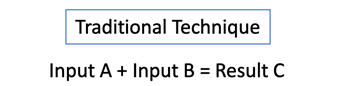
By using ML, the system is given examples, from which it learns how the data should be processed.

Once the system has seen enough datasets, the ML learning functions learn that A & B should be added together to give the result. The key advantage of ML is its powerful flexibility. If we feed our example system with new datasets, the same configuration could be used to subtract, multiply, divide or calculate sequences all without the need for specific equations.
Possibly without realising it, we already see ML in everyday life. When you open Netflix, Amazon Prime Video or Apple TV+ the recommended selections you are presented with are derived using ML. The systems learn the types of content each of us enjoy by interpreting our previous behaviour.
Most of us also have experience of personal assistants such as Amazon’s Alexa and Apple’s Siri. These systems are excellent examples of AI using natural speech to both understand our instructions and then communicate answers, or results of actions. ML not only powers the understanding of language but also provides many of the answers to our questions.
The fact that we all can recognise such an effective and powerful everyday example shows just how far AI and ML have come since their inception in the 1950s.
Voice recognition software has been available for decades; however, it has not made large inroads into the lab. It has been used in areas where extensive notes are taken, areas such as pathology labs or for ELN experiment write ups. These are the obvious ‘big win’ areas because of the volume of text that is traditionally typed, the narrow scope of AI functionality needed, and the limited need to interface to other systems.
However, companies such as LabTwin and LabVoice are pushing us to consider the widespread use of not just voice recognition, but natural language voice commands across the lab. Logging samples into LIMS, for example, is generally a manual entry, with the exception of barcode scanners and pre-created sample templates, where possible. Commands such as “log sample type plasma, seals intact, volume sufficient, from clinic XYZ” is much simpler than typing and selecting from drop downs. Other functions such as “List CofAs due for approval”, “Show me this morning’s Mass Spec run” would streamline the process of finding the information you need.
Take stability studies where samples are stored in various conditions (such as temperature, humidity, and UV light) for several years and ‘pulled’ for analysis at various set points throughout the study.
The samples are analysed for decomposition across a matrix of conditions, time points and potentially product formulations or packaging types. Statistics are produced for each time point and used to predict shelf life using traditional statistics and graphs.
Stability studies are expensive to run and can take several years to reach final conclusions.
AI and ML could, with access to historical data, begin to be used to limit the size of studies so they can focus on a ‘sweet spot’ of critical study attributes. Ultimately, this could dramatically reduce study length by detecting issues earlier and predicting when failure will occur.
Instrument downtime, particularly unscheduled, is a significant cost to laboratories. Using ML to review each new run, comparing it with previous runs and correlating with system failures, could predict the need for preventative maintenance.
AI/ML interventions such as these could significantly reduce the cost of downtime. This type of functionality could be built into the instruments themselves, systems such as LIMS, ELN, Scientific Data Management Systems (SDMS) or instrument control software. If this was combined with instrument telemetry data such as oven temperature, pump pressure or detector sensitivity we have the potential to eliminate most unplanned maintenance.
Another major concern with instrumentation in labs today is scheduling and utilisation rates. It is not uncommon for instruments to cost hundreds of thousands of pounds/dollars/euros, and getting the highest utilisation rates without obstructing critical lab workflows is a key objective for labs. However, going beyond the use of instrument booking systems and rudimentary task planning is difficult. Although it is not hard to imagine AI and ML monitoring systems such as LIMS and ELN, there is far more that can be done to ensure this functionality can go even further. Tasks such as predicting workload; referring to previous instrument run times; calculating sample / test priority; and even checking for scientist’s free diary slots are all tasks that can be optimised to improve the scheduling of day-to-day laboratory work. The resulting optimisation would not only reduce costs and speed up workflows, but would dramatically reduce scientists’ frustration in finding available instruments.
Over the last few years, there has been a massive focus on data integrity within regulated labs. However, many of the control mechanisms that are put in place to improve integrity or mitigate issues are not real-time. For instance, audit trail review is often done monthly at best, and generally quarterly. Not only is it tedious, it is all too easy to miss discrepancies when reviewing line upon line of system changes.
ML could be used to monitor the audit trails of informatics systems and instrument systems in real-time and AI could report any out of the ordinary actions or result trends that do not ‘look’ normal to managers. Where appropriate, the system could interact with the corporate training platform and assign specific data integrity training to applicable teams. The potential increase in integrity of data while reducing the headcount needed to do so could be significant.
Lab directors, IT professional and the Lab Informatics industry are quite rightly focusing on the digital lab and digital lab transformations. Done right, this will form and excellent platform for the next level of informatics development using AI and ML to propel not just digital science forward, but to revolutionise the everyday life of scientists. Personally, I cannot wait!
To find out more about how Scimcon can support your informatics project, contact us today.
