
In order to work as intended, this site stores cookies on your device. Accepting improves our site and provides you with personalized service.
Click here to learn more
Click here to learn more
A few months ago I read an article on bioprocess 4.0, which discusses how combining AI and ML with extensive sensor data collected during biopharmaceutical manufacturing could deliver constant real-time adjustments, promising better process consistency, quality and safety.
This led to a discussion with some of my colleagues about what the future of Lab Informatics could look like when vendors start to integrate AI and ML into products such as lab information management systems (LIMS), electronic lab notebooks (ELN) and others.
AI: In simple terms, AI (artificial intelligence) makes decisions or suggestions based on datasets with the ultimate aim of creating truly instinctive system interfaces, that appear like you are interacting with a person.
ML: ML (machine learning) is one of the methods used to create and analyse the datasets used by AI and other system modules. Crucially machine learning does not rely on a programmer to specify the equations used to analyse data. ML looks for patterns and can ‘learn’ how to process data by examining data sets and expected outcomes.
The following example is extremely simple, but it helps to illustrate the basic principles of ML. The traditional approach to adding two values together is to include the exact way the data should be treated within the system’s configuration.
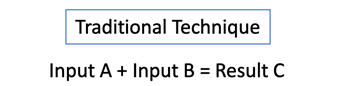
By using ML, the system is given examples, from which it learns how the data should be processed.

Once the system has seen enough datasets, the ML learning functions learn that A & B should be added together to give the result. The key advantage of ML is its powerful flexibility. If we feed our example system with new datasets, the same configuration could be used to subtract, multiply, divide or calculate sequences all without the need for specific equations.
Possibly without realising it, we already see ML in everyday life. When you open Netflix, Amazon Prime Video or Apple TV+ the recommended selections you are presented with are derived using ML. The systems learn the types of content each of us enjoy by interpreting our previous behaviour.
Most of us also have experience of personal assistants such as Amazon’s Alexa and Apple’s Siri. These systems are excellent examples of AI using natural speech to both understand our instructions and then communicate answers, or results of actions. ML not only powers the understanding of language but also provides many of the answers to our questions.
The fact that we all can recognise such an effective and powerful everyday example shows just how far AI and ML have come since their inception in the 1950s.
Voice recognition software has been available for decades; however, it has not made large inroads into the lab. It has been used in areas where extensive notes are taken, areas such as pathology labs or for ELN experiment write ups. These are the obvious ‘big win’ areas because of the volume of text that is traditionally typed, the narrow scope of AI functionality needed, and the limited need to interface to other systems.
However, companies such as LabTwin and LabVoice are pushing us to consider the widespread use of not just voice recognition, but natural language voice commands across the lab. Logging samples into LIMS, for example, is generally a manual entry, with the exception of barcode scanners and pre-created sample templates, where possible. Commands such as “log sample type plasma, seals intact, volume sufficient, from clinic XYZ” is much simpler than typing and selecting from drop downs. Other functions such as “List CofAs due for approval”, “Show me this morning’s Mass Spec run” would streamline the process of finding the information you need.
Take stability studies where samples are stored in various conditions (such as temperature, humidity, and UV light) for several years and ‘pulled’ for analysis at various set points throughout the study.
The samples are analysed for decomposition across a matrix of conditions, time points and potentially product formulations or packaging types. Statistics are produced for each time point and used to predict shelf life using traditional statistics and graphs.
Stability studies are expensive to run and can take several years to reach final conclusions.
AI and ML could, with access to historical data, begin to be used to limit the size of studies so they can focus on a ‘sweet spot’ of critical study attributes. Ultimately, this could dramatically reduce study length by detecting issues earlier and predicting when failure will occur.
Instrument downtime, particularly unscheduled, is a significant cost to laboratories. Using ML to review each new run, comparing it with previous runs and correlating with system failures, could predict the need for preventative maintenance.
AI/ML interventions such as these could significantly reduce the cost of downtime. This type of functionality could be built into the instruments themselves, systems such as LIMS, ELN, Scientific Data Management Systems (SDMS) or instrument control software. If this was combined with instrument telemetry data such as oven temperature, pump pressure or detector sensitivity we have the potential to eliminate most unplanned maintenance.
Another major concern with instrumentation in labs today is scheduling and utilisation rates. It is not uncommon for instruments to cost hundreds of thousands of pounds/dollars/euros, and getting the highest utilisation rates without obstructing critical lab workflows is a key objective for labs. However, going beyond the use of instrument booking systems and rudimentary task planning is difficult. Although it is not hard to imagine AI and ML monitoring systems such as LIMS and ELN, there is far more that can be done to ensure this functionality can go even further. Tasks such as predicting workload; referring to previous instrument run times; calculating sample / test priority; and even checking for scientist’s free diary slots are all tasks that can be optimised to improve the scheduling of day-to-day laboratory work. The resulting optimisation would not only reduce costs and speed up workflows, but would dramatically reduce scientists’ frustration in finding available instruments.
Over the last few years, there has been a massive focus on data integrity within regulated labs. However, many of the control mechanisms that are put in place to improve integrity or mitigate issues are not real-time. For instance, audit trail review is often done monthly at best, and generally quarterly. Not only is it tedious, it is all too easy to miss discrepancies when reviewing line upon line of system changes.
ML could be used to monitor the audit trails of informatics systems and instrument systems in real-time and AI could report any out of the ordinary actions or result trends that do not ‘look’ normal to managers. Where appropriate, the system could interact with the corporate training platform and assign specific data integrity training to applicable teams. The potential increase in integrity of data while reducing the headcount needed to do so could be significant.
Lab directors, IT professional and the Lab Informatics industry are quite rightly focusing on the digital lab and digital lab transformations. Done right, this will form and excellent platform for the next level of informatics development using AI and ML to propel not just digital science forward, but to revolutionise the everyday life of scientists. Personally, I cannot wait!
To find out more about how Scimcon can support your informatics project, contact us today.
As a leader in a pharmaceutical or life sciences organisation, getting the most out of your team and resources is always a top priority. After making the decision to proceed with a critical investment in consulting services, there may even be more pressure to find the optimal use of these time-limited external resources. So, how can you make sure you are using these resources to their full potential? In this blog, our industry expert Micah Rimer will show you how.
During Micah’s 20 years’ working at big pharma & vaccines corporations, including Bayer, Chiron, Novartis and GSK, he has successfully deployed consultancy groups within lab informatics and clinical projects. Micah has worked with Scimcon to support his teams on high profile critical projects
As with any business situation, it is important that there is a common goal that everyone is aligned around.
It is essential that you do not waste valuable time revisiting the same conversations. Ask yourself: “Is it obvious what problem we are trying to solve?” Often, issues can arise when people are arguing about implementing a solution, whilst losing sight of the challenge at hand.
Take the example of Remote Clinical Monitoring: You might decide that it would be beneficial to have your Clinical Research Associates (CRAs) track and monitor the progress of a clinical study without traveling to clinical sites. That sounds like it could be very promising, but what is the problem that needs to be solved?
Without clear goals on what you want to accomplish with Remote Clinical Monitoring, it will be difficult to declare an implementation a success. In addition, if you and your organisation do not know what you are trying to achieve with a particular technical solution, it will be impossible to give your informatics consultants a clear set of deliverables.
So, first things first, agree on the problem statement!
One of the first times I hired Scimcon to support me with an informatics project, I had recently joined a pharma company and found myself in the middle of conflicting department objectives, with what seemed to be no clear path out of the mess I had inherited. The organisation had purchased an expensive new software system that had already become a failed implementation. After spending a year continuously configuring and programming it, it was no closer to meeting the business needs than when the project had started. There were two loud criticisms to address on that point:
This also highlighted a far wider range of issues, such as some people who felt their skills were not being properly utilised while problems went unsolved, and that the bioinformatics department might not have the right goals to begin with.
To solve this challenge, we sat down with Scimcon to identify all the different problems associated with the inherited project, and to clarify what we needed to do to turn it into a success. In taking time to review the situation and without too much effort, we were able to come up with four key areas to address:
With the help of Scimcon, we were able to define these problems and then focus on finding answers to each of the questions. In the end it turned out to be one of our most successful engagements together, award winning even. By just asking senior management what their biggest challenge was, we found their overriding priority was to have an overview of all the R&D projects going on. And while the new software was not particularly well suited for solving the bioinformatics problem that it had been acquired for, it could easily be used to map out the R&D process for portfolio tracking. Then, we turned our attention to the bioinformatics problem, which was easily solved by a bit of custom code from one of the bioinformatics programmers who felt that previously his skills were not being properly utilised.
Once we knew where we were, and where we wanted to get to, all we had to do was get there one challenge at a time.
Once you have identified and agreed on the problem that you want to solve, the next step is making sure the organisation is ready to work with your consultants. As with all relationships, business or otherwise, a crucial step is to make sure that everyone has the same expectations, and that all the relevant stakeholders are on the same page.
People have many different perspectives on why consultants are brought in.
As there can be so many different roles and perspectives on the use of consultants, you need to make sure that you address all the different stakeholder perspectives. It is important to establish a positive situation, as you want the consultants to be able to work with your teams without unnecessary tension.
When I was just starting out with my first LIMS implementation (Laboratory Information Management System), I remember being impressed that you could hire someone who had the specific experience and expertise to guide you on something they had done before but that was new to you. I wondered, “why was that not done all the time? Why do so many implementation projects fail when you can bring people in who had solved that particular problem before?” When I asked Russell Hall, a consultant at Scimcon for us on that first project, he said that not everyone is comfortable admitting they need help. As my career has progressed, I have come to value that feedback more and more. There are many people who are highly competent and effective in their jobs, but are not comfortable with the appearance that they are not sufficient on their own. It is always important to manage for those situations, rather than assuming that everyone will welcome external help.
Lastly, it is also critical to manage expectations, regarding the use of consultants. Your boss may need to defend the budget, or be prepared to stand behind recommendations or conclusions that are delivered from people outside of the organisation. It should also be considered that management might not readily accept something that might seem obvious to employees working at a different level. By liaising with senior leaders from the outset, you can make sure both parties are aligned how the consultants will interact with people in the company, and what their role will be. This is important both to achieve what you want internally and also to make sure the consultants have a proper expectation of how their efforts will be utilised.
While it can be very tempting to feel that you can leave the majority of the project to the experts, the reality is things rarely go as smoothly as planned. As the life science business and information management have advanced over the last few decades, the amount of complexity and details has grown tremendously. It is more and more difficult for a single person to maintain an overview of all the relevant facts. The only way to be successful is to communicate and make sure that the right people have the right information at the right time. Your consultants are no different.
Many organisations have challenges in terms of taking decisions and communicating them effectively. For your consultants who do not typically have all the same access and networks in the organisation that internal staff do, it is imperative that you make sure they are kept up to date. You want to avoid them spending valuable time on focusing on areas and deliverables that have shifted to being less important. Finding ways to keep consultants informed on all the latest developments is absolutely necessary for them to be able to deliver successfully. Figure out what makes sense by considering the organisation culture and the consulting engagement setup. Whether it is by use of frequent check-ins or online collaboration, be prepared to put in additional efforts to make sure that the information gets to where it needs to go.
As well as good communication, organisations have to be able to adjust as needed. Occasionally everything does work out according to plan, but that is more the exception than the rule when it comes to complex life science informatics projects. While timelines and commitments are critical, it is important to view any project as a collaboration. There will be unexpected software issues. There will be unplanned organisational changes and problems. People get sick, life happens. By having open and continuous dialogue, you can be best prepared to make the adjustments needed to find solutions together to unexpected problems.
Consultants can be hugely valuable to you and your organisation.
But you have to setup the right conditions for everything to work out well.
Working together, you can get to where you need to go.
If you’re interested in working with Scimcon on your upcoming informatics project, contact us today for a no-commitment chat about how we can help you succeed.
Top tips for choosing an informatics consultant?
Turing award laureate Mike Stonebraker and I co-founded Paradigm4 in 2010 to bring technology from Mike’s MIT lab to the commercial science community to transform the way researchers interrogate and analyse large-scale multidimensional scientific data. The aim was to create a software platform that allowed scientists to focus on their science without getting bogged down in data management and computer science details – subsequently enabling more efficient hypothesis generation and validation, delivering insights to advance drug discovery and precision medicine.
Throughout his 40 years working with database management systems, Mike heard from scientists across disciplines from astrophysics, climatology and computational biology that traditional approaches for storing, analysing and computing on heterogeneous and highly dimensional data using tables, files and data lakes were inefficient and limiting. Valuable scientific data—along with its metadata—must be curated, versioned, interpretable and accessible so that researchers can do collaborative and reproducible research.
We created a technology (REVEAL™) that is purpose-built to handle large-scale heterogeneous scientific data. Storage is organised around arrays and vectors to enable sophisticated data modelling as well as advanced computation and machine-learning. This enables scientists to ask and answer more questions, and get more meaningful answers, more quickly.
Translational research is the process of applying ideas, insights and discoveries generated through basic scientific inquiry to the treatment or prevention of human disease. The philosophy of “bench to bedside” underpins the concept of translational medicine, from basic research to patient care.
There are a number of benefits to streamlining translational research, as it gives scientists the ability to integrate ‘OMICS data, clinical, EMR, biomedical imaging, wearables and environmental data to build a rich, systems-level understanding of human biology, disease and health.
We are actively working with leading biopharma companies globally, as well as research institutes. One of our current projects is working with Alnylam Pharmaceuticals to expedite their research leveraging one of the biggest genetic projects ever undertaken – the UK Biobank. Over 500,000 people have donated their genotypes, phenotypes and medical records. With so much data available on such a large scale, Alnylam’s scientists faced a challenge when it came to extracting meaningful information and making valuable connections that could unlock breakthroughs in scientific research.
The UK Biobank captures genomics, longitudinal medical information and images, so having all that data in one place allows researchers to correlate someone’s traits and presence/absence of a disease, or even susceptibility to diseases like COVID-19, with their genetic make-up. Alnylam has used our technology to help use these correlations to investigate causes of disease and identify potential treatments.
The idea of precision medicine – delivering the right drug treatment to the right patient at the right time and at the right dose – underpins current thinking in healthcare practice, and in pharma R&D. However, until single-cell ‘OMICS came along, researchers were looking at an aggregated picture – the ‘OMICs of a tissue system, rather than that of a single cell type. Now, single-cell analysis has become a major focus of interest and is widely seen as the ‘game changer’ – with the potential to take precision medicine to the next level by adding ‘right cell’ into the mix.
We offer biopharmaceutical developers the ability to break through the data wrangling, distributed computing and machine-learning challenges associated with the analysis of large-scale, single-cell datasets. Users can then build a multidimensional understanding of disease biology, scale to handle more samples from patients with more cells, more features, broader coverage and readily assess key biological hypotheses for target evaluation, disease progression and precision medicine.
By using our platform data are natively organised into arrays that can easily be queried with scientific languages, such as R and Python. The old way of working –– opening many files and transforming into matrices and data frames for use with scientific computing software –– is no longer necessary, because the data are natively “science-ready”. For companies that have tens of thousands of data sets, aggregation of that data in a usable format is tremendously empowering.
Our “Burst Mode” automated elastic computing capability makes it possible for individual scientists to run their own algorithms at any scale without requiring the help of IT or a computer scientist. The software automatically fires up and shuts down hundreds of transient compute workers to execute their task. Any researcher can access the power of hundreds of computers from a laptop.
When Covid-19 hit earlier last year we partnered with a leading pharma company to identify tissues expressing the key SARS-CoV-2 entry associated genes.. We found they were expressed in multiple tissue types, thus explaining the multi-organ involvement in infected patients observed worldwide during the ongoing pandemic.
The first data sets were from the Human Cell Atlas (HCA) and the COVID-19 Cell Atlas. Questions such as “Where is the receptor for SARS-CoV-2” or “What are the tissue distribution and cell types that contain COVID-19 receptors?” can be answered in 30 seconds or less, with responses from 30 or more data sets (since expanded to ~100). More advanced questions can now be investigated, such as the causes for complications and sequelae seen in some patients. Rather than organising all of those data, researchers can focus their attention on unlocking answers.
It has allowed us to support scientists in breaking through the complexities of working with massive single cell, multi-patient datasets. Accelerating drug and biomarker discovery is a key driver for our customers.
The life science community, as well as more commercially oriented research and development groups in pharma and biotech, understand that they need to use leading edge algorithms and cost-effective, scalable computational platforms to give them the ability ask and answer questions in seconds instead of weeks to push forward discovery. Paradigm4 gives the confidence to make earlier and adaptive change decisions that will shorten development, and provide earlier access to complex, real-time data that can detect efficacy and safety signals sooner. Importantly, working in partnership with these users, we will further improve and develop the capabilities in analysing datasets, benefitting researchers as they continue to strive for better results.
Meet Scimcon: Geoff Parker?That’s an easy question, I love the constantly changing challenges that informatics consultancy throws up and helping customers and our own internal teams to creatively meet those challenges.
We help customers in pharma, biopharma, and clinical trials to identify and evaluate the goals and challenges ahead and use this to influence information system strategies. We assist with programme and project direction; vendor and product selection (of LIMS, SDMS, ELNs and ePRO solutions); and to drive successful software implementations.
The works is often equal parts frustrating, challenging, and exciting but as people who have been involved in this type of work will recognise, it is ultimately extremely rewarding.
I am somewhat cursed by having multiple passions to fit into my spare time. Being a keen mountain biker, avid photographer and relentless traveller does present some time-management dilemmas.
Photography is something I have been fascinated by since I was at school, and is something that I have picked up and put down intermittently since then. However, three years ago I was lucky enough to spend a week riding bikes with a professional photographer and this really inspired me to develop my skills and style. You can view some of my results of my photography journey on my portfolio site.
My addiction to mountain biking started when I moved to Scotland ten years ago, as there is some of the best riding in the world, right here. The mixture of physical demands, technical riding skills and the pure pleasure of being surrounded by forest and mountains has proved irresistible. Not that the abundance of local riding has stopped me traveling with my bike. Ten years of truly amazing riding has taken me to some of the best trails in Morocco, Nepal, USA, New Zealand, Switzerland, Norway, Iceland, and Chile! Like most people, I am looking forward to when travel once again becomes possible, then maybe I can put my planned trips to Kyrgyzstan and Bhutan into action.

I’m not sure I can pick a favourite, as it depends on the activity involved. For a chilled afternoon walk drinking coffee, I would have to say San Francisco. Relaxed attitude, wide open streets and great culture make it a hard place to beat.
For mountain biking, it could be any of those places I mentioned above. My trip spending a week on HMS Gassten, a converted World War Two minesweeper, with a group of good friends riding high above the fjords in Norway deserves special mention. Also, I think Nepal’s Mustang Valley was a special trip. Amazing culture, fantastic people, and as for those mountains – they build them big over there!
The biggest difference is that I have been at home for the longest period in about 22 years! In the last 12 months, I have only managed to travel down to our office in Newmarket twice (from my home in Scotland). I would normally travel 2 or 3 weeks out of 4, so it has been a big change.
Distancing from family and friends has also been difficult, as it has for most. I have stayed in touch as much as possible with family and friends the same way anyone else has; telephone calls, meeting in car parks and standing 4 metres apart, in addition to several Zoom quizzes!
I have had a long fascination with technology, which of course in part has led to my role at Scimcon. We have obviously come a long way since I first became involved in technology. I started programming on home computers during the explosion of affordable devices in the UK during the early 1980s.
Everything has continued to stem from there, to a point where I’m now the co-founder of a scientific technology consultancy, using technology to drive change and deliver scientific value.
In terms of devices, I use pretty much anything you can imagine. I have electronic shifting on a couple of my bikes, and I have some amazing camera equipment that even five years ago would have been inconceivable.
I don’t think my use of technology in my everyday is too different to how I would use it at work. At Scimcon we try to use technology in a way that enhances people’s work lives, so that they can focus on what is important. If I look at technology in bikes and cameras, what excites me is the same thing – not the technology itself, but what it allows you to do.
For example, when I started photography at school, the process was incredibly different to how it is now. You tried different methods of taking photographs and would be left with a roll of film afterwards that if you were lucky, you’d get developed a week later. Of course, you could guarantee that you would get the photos back after all that time and wonder “what on earth was I trying to do?” Nowadays, we have digital cameras, so you take the photo, see the result, and if it does not work you can just try again instantly.
That’s exactly how we try to use technology at Scimcon. We don’t want technology to get in the way or slow down the result you want to achieve, we want it to enable you to do the work you are trying to do – whether that’s riding bikes, taking photographs, or integrating your LIMS to streamline your workflow.
I find building a company from the ground up very exciting, so that is always a leading factor behind starting a new business. Divesting is never the intention when building a business, it is more something that becomes clear over time. The motivation behind starting my businesses is to create value and deliver a meaningful impact into the pharmaceutical and life science space, in whatever shape that may take.
Take Sciformix, for example. As with my other businesses, Sciformix was created in the right place at the right time, offering our ability to combine science and process at a time when other outsourced businesses were only offering one or the other. When creating Sciformix, the intention was not to divest at a later stage, but to deliver value in what was, at the time, a new area in science.
CROs and regulatory consultants had been around for a long time when I founded Sciformix, but pharmacovigilance (PV) was a relatively new area in the industry. As regulations tightened on the reporting of adverse events within clinical trials, the pharmaceutical industry sprang into action, and it soon became clear that the new pharmacovigilance processes were too much, and too lengthy to all be completed in-house within the 15-day deadline for reporting serious reactions. These regulations were very new when we built Sciformix, and as a result we grew very quickly and worked through roughly one and a half million cases per year. When the time was right to divest, Sciformix was acquired by Covance, and it was time to move on to the next venture (Scitara).
When you are working on your business, there is not a conscious decision to divest. You know when the time has come to move on – it is like you flip a switch and realise it is time for something new, and you begin to ask yourself “why would I sell?”
Timing is critical when considering divesting. Is it the right time for your customers? Is it the right time for your employees? And is it the right time for your investors? If it is the right time for all three of these areas, then you can begin the transition fairly quickly. However, if only one or two of these areas are ready for this change, you need to step back and ask yourself “how can I make it the right time for all three?”. Thankfully, all of my exits have been at a point where the time has been right for all three parties, so I have left my businesses smoothly and on good terms.
Interestingly, a lot of our customers often prefer to work with smaller companies, such as those which I founded, over larger companies who offer similar services. The benefit of smaller outsourced companies – well, small in comparison to the customer – is that the culture is quite different. Smaller companies and agencies can offer a level of flexibility and innovation to customers that can be difficult to pass through larger organisations. In addition, there is a real sense of an “I have your back” attitude, as you are able to work closely with your customers. Culturally and contractually, my companies have been able to offer something different to larger companies, and we have been willing to do anything and everything our customers needed, which is why they would often choose to sign up with us.
However, as the business grows, those customers tend to stay. When customers become a part of your journey, your relationship with them evolves and your company becomes better equipped to protect their business. Because I aim to divest at a time when my customers are ready for it, there is generally a smooth transition.
As my previous three ventures were in tech, services, and global delivery, Scitara is the summation of all of my previous projects. As I mentioned in the last blog, Scitara aims to solve the major problem within the lab industry of data connectivity and is leading the digital revolution in labs to address this issue. To do this, we will require the cooperation of every connection we have made over the years, as by helping us, we can help them. If we can reach out to everyone in the ecosystem, we will be able to help companies take a huge leap into their digital transformation projects by creating a platform through which they can communicate their lab data through their digital systems, something which at present is proving a real hindrance to digital transformation projects.
This is why I believe Scitara is my finale. It is almost as if we have come full circle, as Scitara pulls together the skills and relationships I have built over my entire career – into creating a final solution. I intend to go out with a bang!
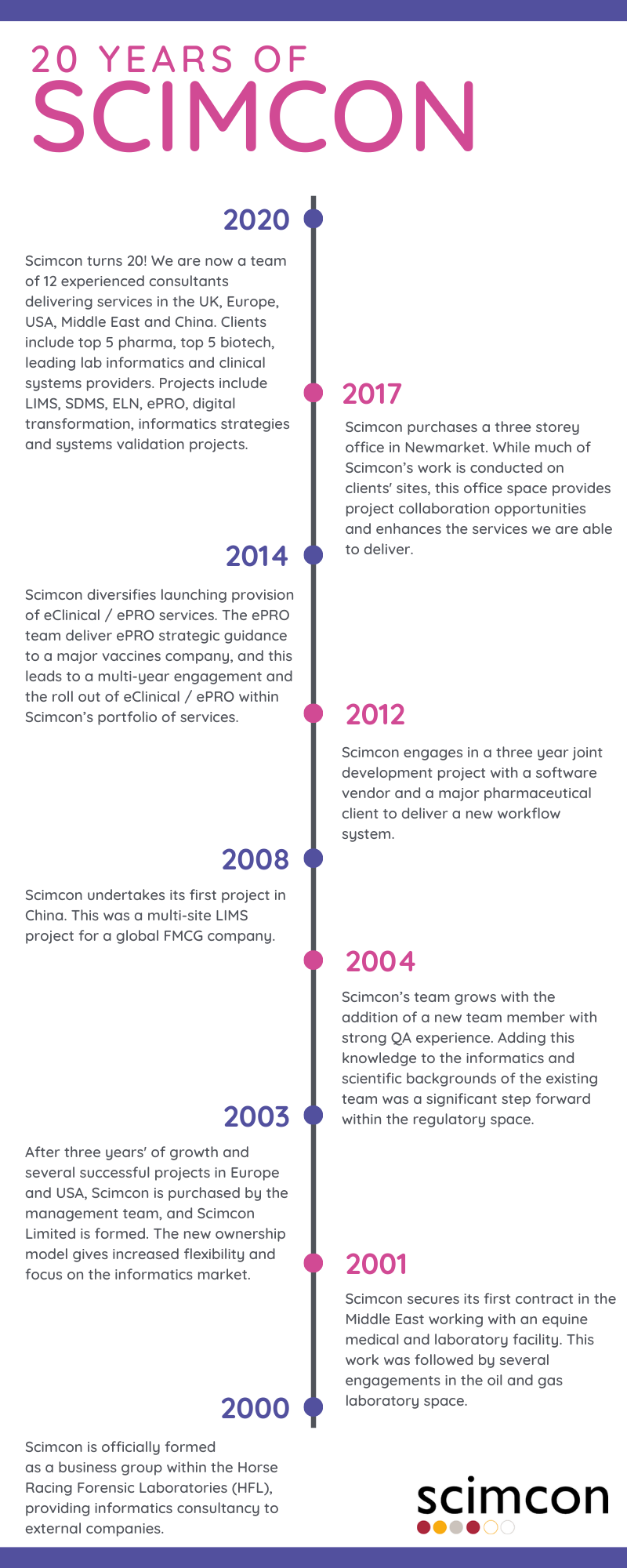
20 Years of Scimcon – a timeline of our history?In 2020, we celebrate Scimcon’s 20th birthday! Since 2000, Scimcon has evolved from a boutique life sciences informatics consultancy based in Newmarket, to the global supplier that we now are, working with some of the largest pharma and biopharma companies worldwide.
As we look back over our 20 years, we have created a timeline to celebrate some of our most memorable milestones. From our first contract, to our expansion of services, to our first office building – our first 20 years have certainly not disappointed.
We would like to thank all Scimcon’s clients, partners and consultants who have worked with us and supported our journey over the last two decades.

Prior to joining Scimcon I had worked for large and medium sized corporations. I enjoyed my time in these organisations, but one of the qualities that initially attracted me to Scimcon was the small, close nit team that felt more like a family where every individual really matters to the success of the company. As it is a small company, you cannot hide, sit back and let others do the work for you. Everyone pulls their weight, and we back each other up if we face challenges.
Scimcon has also allowed me to work on a variety of interesting projects in areas I may not have been able to access in my previous roles.
I have always had an interest in photography, but my real passion lies in astrophotography. My degree was in Physics and Astronomy, and I have therefore always had a fascination with the Universe. I like to take photos of the Milky Way, and I have travelled to Lapland and Iceland where I was lucky enough to have been able to get photos of the Aurora Borealis. I also recently took a photo of the Neowise comet over Ely Cathedral. My 9-year-old daughter has recently become interested in photography, so when we get chance to go for a walk in the countryside as a family, we take our cameras and try to get some landscape photos or photos of flowers, birds, and similar.


Something else I do in my spare time is exercise – I would not say it was a hobby, but more of a chore! I exercise for at least an hour a day, six days a week. This consists of two days at my local bootcamp at 6:20am, outside in the cold, dark and often rain in the winter, with an instructor and a team of about 20 other people. The other four days are purely aerobic, either jogging or using the cross trainer. I am a member of my local gym where I used their cross trainer, but due to the lockdown closing all gyms back in March I bought my own, and haven’t been to the gym since.
When I get the opportunity, I like to have a round of golf too. I usually play with my Dad who is a member of his local golf club, however I do not do it very often as 18 holes usually takes up three hours at least. As I do not play too often, I’m not terribly good, but conversely, I’m not terrible.
When we go on holiday we like to travel to interesting places and try to immerse ourselves in the culture. Some of the more interesting places we have been on holiday are; as mentioned above, Lapland and Iceland, but we have also been to Beijing and walked along the Great Wall of China, Istanbul, Malaysia, Singapore. Once COVID-19 is behind us we would like to take the kids to Australia and Japan.
Prior to COVID-19, it was nice to spend time with friends, having a drink and a laugh, however with the changing restrictions it is not something we get to enjoy regularly at the moment. One thing my friends and I enjoyed doing was a games night. Poker, Black-Jack and Trivial Pursuit; it’s very light-hearted, but it brings out the competitive nature in people.
With the restrictions discouraging activities with people outside of your household, we have recently taken up coarse fishing as a family. It is something that we thought would be something fun to do, to get out of the house and enjoy together. We fish on the nearby Great Ouse river and catch fish such as perch, roach and rudd. It is purely something we do for fun, so we always return the fish back to the river.
This question brings a smile to my face as my wife knows only too well how much I like technology, much to her annoyance. Over the years I have added more and more Philips Hue lights to the house, to the point where every room has at least one. We use Alexa to turn lights on and off.
Similarly, we have a number of Sonos speakers around the house which are also controlled through Alexa. I like the idea of having an electronic assistant, I think it reminds me of some scifi films of the 80’s and 90’s.
I use a Macbook and Adobe Lightroom to edit photos and I share them on Instagram (if I think they’re good enough).
My use of technology at home is very different to work. However, I think the skills I learn from setting up a new device or configuring the way it works can be applied to my work. The use of these devices, and the associated interconnectivity in the home setting helps me keep abreast of the latest technology, which has applications within projects at work too
Clearly good cell network or WIFI connectivity is of primary importance when thinking about using ePRO in a clinical study. Sites should conduct a feasibility activity in their local vicinity during the study initiation phase to understand if cell network strengths are good enough for ePRO and if not, if there is likely to be a large population of subjects that have home WIFI. For remote locations with possible issues with either the cell network coverage or even with the availability of electricity, these sites should be reconsidered before a decision is made to use ePRO.
However, even with bad cell network coverage, it is possible to conduct a study with ePRO by ensuring the correct messaging appears to the subjects on the device. All ePRO systems allow the subjects to access and complete their diaries on a daily basis without cell or WIFI connectivity. The data entered by the subject is stored on the device until connectivity is established. There are circumstances where the site may need to be made aware of certain responses in real time in order to maintain subject safety. If connectivity is established and the data is sent in real time, the site staff may receive an alert from the system asking them to contact the participant. In order to ensure participant safety is maintained it is good practice to alert the participant to contact the sites / study doctor if certain responses in the diary are provided, such as if the participant required emergency medical attention.
As mentioned earlier in an earlier instalment, translation is an aspect not typically associated with clinical systems such as EDC. Additionally, because the ePRO devices are in the hands of the participants, the screens, in their local languages, must be submitted to the local ethics committees within the countries that the study is to take place in.
It should not be forgotten that paper PRO is also subject to a translation process. However, the additional complexity with ePRO is the need to apply the translated text to the software in order to generate the questionnaire screens. This involves multiple review and update rounds between the ePRO vendor and the translation vendor which increases time, effort and therefore cost. Once the screens are generated there may be further review rounds during the in-country review between the local sponsor representatives, ePRO vendor and translation vendor. All of these review rounds increase the timescales for an activity that is already time critical.
Often the date for submission to the ethics committee is set during the planning phase of the study by the sponsor study team. If the submission date is missed it could result in a delay to the study start. Consequently, it is important to ensure clear timelines are in place between agreeing the ePRO requirements, which will decide what is displayed on each of the screens, and submitting the screen report to the ethics committees. The ePRO vendor will need to be made aware of these timelines at the earliest opportunity. It can take more than 12 weeks for the completion of the translations resulting in the creation of the finalized screen reports. These timelines are difficult to manage if the process includes an in-country review round which allows for local country representatives from the sponsor to review the translations. It is important to make clear to the reviewers what it is that these stakeholders are reviewing. Translation is not an exact science. There are many ways of writing the same sentence. As the translator is the trained expert in translations it should be left to them to choose the most appropriate wording in the local language which most faithfully represents the English version. The in-country review, if indeed one is required, should only be conducted to ensure the correct screens are displayed in the screen reports. Allowing the in-country reviewer to make suggestions on preferred wording risks multiple back and forth review rounds, increasing timelines and jeopardizing study start dates.
As briefly mentioned in part one of this series, possibly the most crucial aspect when introducing a new system or process to a user base is change management. If you do not bring your users along the journey with you, you are less likely to gain their acceptance.
How does this manifest itself? With ePRO there is plenty of opportunity for issues to arise, from delays in getting devices to sites, to errors in the software, to usability and connectivity issues. All of which can affect the investigators ability to get on with their daily work. If you have not put in place a good change management process you will find the investigators very quickly become disenchanted with the system and even the smallest of issues will become magnified, resulting in escalations to the sponsors senior management team.
It is important from the outset to set the stage with the investigators. Why are we using ePRO? What benefits does it bring to the sponsor? It may require more work on behalf of the investigator which will need to be compensated for. It is also about setting expectations. Things will go wrong, issues will need to be resolved, backup processes may need to be utilized, but the investigator must be aware that they have the support when needed and how they can access that support.
When implementing ePRO thought should go into understanding how to improve the investigators experience. For example, investigators can be working on multiple studies at the same time for different sponsors all using ePRO, so adding labels onto the packaging of shipped devices so that investigators can quickly store them together is a quick win.
As a sponsor it may also be necessary to implement an additional layer of support for the study team. When issues arise the investigator will contact the vendor helpdesk. Often the helpdesk are unable to provide an immediate remedy so the investigator will then contact the sponsor’s study team representatives. The additional layer of support sits between the study team and the vendor, collating issues, communicating technical information back and forth in a manner that is easily digestible and holding the ePRO vendor to account. This relieves the frustration experienced within the sponsor’s study team and reduces the likelihood of escalation.
It is important to remember that in accordance with ICH GCP guidance section 5.2.1 [1] the sponsor may transfer trial-related duties to a vendor, however the ultimate responsibility for the quality and data integrity of the trial data always resides with the sponsor. In order to ensure data is collected, stored and transferred in accordance with ICH-GCP guidance the sponsor will need a suitable oversight strategy of the vendor’s processes. This may, at a minimum, include a qualification activity which involves auditing the ePRO vendor on a regular basis. It may also invoke some internal validation work to ensure, as the sponsor, your own organisation’s technical and study specific requirements for clinical systems are met.
It is not recommended for the sponsor to leave the responsibility of vendor oversight to the individual study teams. The study teams may not have the experience or technical know-how necessary to understand the challenges and considerations discussed earlier in this blog.
We would recommend a two stage process.
Stage one is the qualification of the vendors system by a centralized team including stakeholders from the data management and computer system quality departments. Once qualified, the vendor’s system can be classed as a platform that can subsequently be used on multiple studies.
Stage two is to have experienced stakeholders conduct study specific User Acceptance Testing (UAT) in order to test the many scenarios and nuances associated with ePRO and to ensure the system meets the requirements of the study Protocol. Once implemented and running live on a study it is far more difficult to update the system than finding and fixing the issue during the implementation phase.
However, UAT is the very least the Sponsor must do as part of the overall study specific validation activity (Stage two). The Sponsor’s quality management system (QMS) may also mandate that the implementation of any clinical system (which would include ePRO) requires internal validation documentation to supplement the vendor’s validation package. This can include documents such as a sponsor Validation Plan, Requirements Specification, Risk Assessment, Traceability Matrix and Validation Report.
ePRO vendors will often offer to provide a service to create UAT script on behalf of the Sponsor, however this is not recommended as a misunderstanding of requirements by the vendor may also manifest itself in the scripting. This can result in the script passing when executed when in fact it does not meet the requirements of the Sponsor.
For these reasons, having experienced validation professionals generating the deliverables and executing the testing is recommended.
The two parts of this blog have detailed, at a high level, many of the challenges that can be experienced during the implementation and use of ePRO. These challenges are summarized below:
These challenges, and others, often create frustration for the investigators and study teams, and in the worst case scenarios, studies can be put on hold or stopped completely, costing millions of dollars and preventing a product from going to market.
A mechanism to help mitigate, or at the very least support the investigators and study teams through, many of these challenges is for the sponsor to put in place a centralized ePRO team within their organization. This team, consisting of internal sponsor stakeholders or perhaps supplementing Scimcon resources into the team, would be responsible for the qualification of the ePRO vendor, the strategic implementation of libraries and standards and for supporting the implementation of ePRO study-specifically, providing help with creating validation deliverables and executing UAT, and being a second level of support during the conduct phase of a study. ePRO is fast becoming the standard and it is worthwhile investing early on in an internal team to ensure success.
To discuss how Scimcon can support your organization with the implementation of ePRO, please contact one of our consultants for an informal conversation.
[1] ICH harmonised guideline integrated addendum to ICH E6(R1): Guideline for Good Clinical Practice ICH E6(R2) ICH Consensus Guideline, https://ichgcp.net
