Industry leader interviews: Jana Fischer?

We’re kicking off 2023 with a new industry leader interview, and shining a spotlight on Jana Fischer, Co-Founder and CEO of Navignostics.

In this blog, we speak to Jana about Navignostics’ mission, and how the team plans to revolutionise personalised oncology treatments with the help of data and AI.

Tell us about Navignostics

Navignostics is a start-up personalised cancer diagnostics business based in Zurich, Switzerland. Our goal is simple – we want to revolutionise cancer treatment by identifying a highly personalized and thus optimal treatment for every patient, to ensure that each patient’s specific cancer is targeted and fought as needed. Our capabilities allow us to do this by analysing tumour material, through extracting spatial single-cell proteomics information. and using this data to analyse many proteins simultaneously in individual cells within the tissue.

What is spatial single-cell proteomics?

Single-cell proteomics comprises of measuring and identifying proteins within a single cell, whereas spatial proteomics focuses on the organisation and visualisation of these proteins within and across cells. Combining these two research tools allows the team at Navignostics to characterise tumours on a cellular level, by identifying the proteins present across cells in a tumour, and also how these proteins and cells are organised. This means that the team can provide a more accurate estimate for how certain tumours will respond to different medications and treatments.

Proteins are typically the target of cancer drugs and measuring them on a cellular level allows us to identify different types of tumour cells, as well as immune cells that are present and how the two interact. This data is highly relevant to inform clinicians of the best form of (immuno-) oncology and combinatorial treatment for individual patients. Also, this information is highly relevant to pharma companies in order to accelerate their oncology drug development, by providing insight on drug mode of action, and signatures to identify responders to novel drugs.

The kind of data that we are able to extract from different types of tumours are monumentally valuable, so the work doesn’t stop there. All of the data we harness from these tumours is stored centrally, and we plan on utilising this data by building it into a system we refer to as the Digital Tumour, that will continuously allow us to improve the recommendations we can make to our clinical and pharma partners. Our journey has been rapid, though it is built on years of research and preparation: we founded the business in 2022, as a spin-off from the Bodenmiller Lab at the University of Zurich.

The dream became a reality for us in November 2022, when we secured a seed investment of 7.5m CHF. This seed funding will allow us to pursue our initial goals of establishing the company, achieving certification for our first diagnostic product and developing our Digital Tumour. By extension, collaborating with pharma and biotech partners in oncology drug development. It has also given us the resource we need to move to our own premises. We are due to move off university campus in May 2023. This offers us great opportunity to push forward with the certification processes for our new lab, and it gives us to the chance to grow our team and expand our operation. We will be located in a start-up campus for life science organisations in the region of Zurich, so we’ll be surrounded by companies operating in a similar field and at a similar capacity.

Tell us more about the Digital Tumour – how does it work?

The Digital Tumour will be the accumulation of all the molecular data we have extracted from every tumour that we have analysed to date, and ongoing. Connected to that, we store information on the clinical parameters and patient response to treatment. Over time, our aim is to utilize this central data repository to identify new tumour signatures, and build a self-learning system that will provide fully automated treatment suggestions for new patients, based on how their molecular properties compare to previously analysed patients that have been successfully treated.

Sounds interesting – are there any challenges to working with a database of this size?

Our data storage is quite advanced, so volume isn’t really a challenge for us. Our main focus is standardising the input of data itself. The technology is based on years of research and the data analysis requires a great deal of experience and in-depth expertise. In order to extract the full value from this data, it must be completely standardised. Data integrity is therefore vital to our work, and allows us to get the maximum value from past analyses. Our past experience in the Bodenmiller Lab allowed us to develop standardised processes to ensure that all of our data is fully comparable, which means that we can learn more and more from our past data, and apply this to new cases that we analyse.

It is also important to report on our complex data in a comprehensive but easily interpretable manner to the clinician/tumour board who needs to organise a treatment plan. We’re currently working with our clinical collaborators to develop readily understandable and concise reporting outputs. Unlike genomics analysis, our reports focus on proteins in tissue, which is the same information that clinicians are used to working with. So, there is a common language there that offers us the unique opportunity to provide clinicians with data they can easily interpret and work with.

What does this kind of research and data mean for oncology, both in terms of pharmaceuticals, biologics, and healthcare?

It’s important to note that personalised treatment approaches and precision medicine are not new concepts in the diagnostics space. However, our technology and algorithms allow us to extract novel types of biomarkers which were previously inaccessible or unknown, so we’re helping to level up the playing field and give clinicians and drug developers’ comprehensive information to individualize therapies.

Comprehensive tumour data is truly at the heart of what we do, and one key benefit of our technology is that we’re able to analyse very small amounts of sample – such as fine needle biopsies – to provide therapy suggestions. We can also analyse bio banked tumour material, so if there is any old material that has been stored, we have the ability to analyse those samples retrospectively. Not only does this help us to fuel our Digital Tumour with more data, but it also allows us to examine new fields such as long-term survival rates of patients with these tumours. This is of huge value to fuel our product development pipeline because it allows us to identify different molecular properties between individuals that may not have been considered on a clinical level, but may have played a role in patient responses to treatments and survival outcomes in the long-term.

This kind of retrospective data also plays a key role in the evolution of healthcare and drug development, as having the technologies available to acquire this sort of data and mine it to our advantage will provide enormous benefits. These include improving individual treatment courses for patients, as well as expediting the development of novel cancer drugs so pharma companies can get more effective treatments to market sooner.

For example, one commonly cited statistic is that 90% of clinical drug development fails during phase I, II, III trials and drug approval. Often, this may arise from a lack of available information to identify the subset of patients most likely to benefit from a novel drug. Having access to Navignostics’ technology and algorithms and a database such as the Digital Tumour will offer the potential to pre-select the right patients to enroll in clinical trials, and more easily identify the patients that do respond to the novel treatment, which could substantially expedite the speed of drug development in the trial stage, and help bring more effective drugs to the market.

Even unsuccessful trials offer valuable opportunities: it is possible to repurpose and reanalyse material from previous failed trials. Such high rates of failure in clinical development means that there are a large number of companies that have invested $millions in developing drugs that have not come to fruition, so if companies want to re-mine their data, our team can reinterpret the existing work into identifying more successful strategies, so we can give those drugs another chance and offer a better chance of Return on Investment.

A failure no longer needs to be a failure. Navignostics and its offerings can bring value to our pharma and biotech partners, and will also bring direct benefit to patients and clinicians once we launch our diagnostics product. So, data from every facet of the oncology industry, from curing a patient to halting the development of a drug, can offer us valuable insight that both we and the Digital Tumour could learn from when developing treatments.

What does 2023 and beyond have in store for Navignostics?

The next three years will be critical for our work, and we have projected timelines and key milestones for our diagnostics developments that we will achieve until our next funding round. Along the way, we are actively speaking to biotech and pharmaceutical organisations to identify projects and build the foundation for long lasting collaborations. We are looking forward to a successful continuation of the Navignostics development in 2023!

Scimcon is proud to showcase start-up companies like Navignostics, and we’re looking forward to seeing how the company will grow over the coming years.

To contribute to our industry leader blog series, or to find out more about how Scimcon supports organisation with lab informatics and data management solutions, contact us today.

Scimcon reduces carbon emissions for another year?

Scimcon continues to meet the criteria for Carbon Neutral Britain for a second time in 2022. This has been attained through conducting the required measuring, calculating, and offsetting carbon emissions between the period of June 2021 and May 2022.  

After first receiving the initial award in 2021, we are proud to have maintained this title throughout the following year, underpinning Scimcon’s global commitment to a sustainable future.  

Our commitment to carbon footprint 

Co-founder of Scimcon Geoff Parker recognises the global nature of the company after first obtaining the award in 2021; “Our customer base consists of a diverse range of lab-centric organisations including large pharma and biopharma companies internationally. As Scimcon sees further expansion and more on-site projects in 2022, we are keen to drive our sustainability initiative through the global projects taking place all over the world. Carbon Neutral Britain pledged to offset our remaining carbon usage with accredited global projects that reduce the amount of CO2 in the earth’s atmosphere. After gauging the environmental impact of our operations, we knew this would be a priority of ours moving forward.” 

Global projects  

We renewed our Carbon Neutral Britain certification by offsetting against four international projects set up by our awarding sponsor. The Burgos Wind Project is the largest wind farm in the Philippines. This project produces clean energy, omitting sources that contribute pollutants and greenhouse gas emissions to the environment. Also, the Rice Husk Power Project, the first renewable energy scheme to utilize rice husk as biomass fuel for electricity generation in Cambodia. Not forgetting the remaining two projects, the Andes Mountains Hydro Power in Chile, and the Huaneng Changyi Wind Farm Project. All equally as impactful, we recognise that offsetting our carbon usage against projects like these is vital for our own global strategy here at Scimcon. 

Our impact  

As we continue to operate in the complex lab informatics field, Scimcon’s efforts to reduce carbon emissions must continue to benefit our customers. Scimcon will continue to responsibly balance the very real need for on-site client interaction with the use of innovative communications, thereby reducing the impact of unnecessary travel. If taking part in auditory assessments and remediations like this one offsets our necessary emissions and contributes to a more sustainable future, the Scimcon team is more than dedicated to its requirements.  

For more information about how we originally achieved our certification, visit our blog. To learn how Scimcon can help support your business with its IS strategy, contact us.

Introducing Ben Poynter: Associate consultant, and Scimcon’s newest recruit?

Our team at Scimcon is made up of a talented group of interesting individuals – and our newest recruit Ben Poynter certainly does not disappoint!

Ben joined our Scimcon team in July 2022 as an associate consultant, and has been working with the lab informatics specialists to get up to speed on all things Scimcon. We spoke to Ben about his experience so far, his interests, background, and what he hopes to achieve during his career as an informatics consultant.

To get us started, tell us a bit more about your background.

So, I studied Biomedical Science at Sheffield Hallam University, which was a four-year course and allowed me to specialise in neuroscience. During my time at university, I created abstracts that were presented in neuroscience conferences in America, which was a great opportunity for me to present what I was working on. My final year dissertation was on bioinformatics in neuroscience, as I was always interested in the informatics side of biomedical science as well.

Once COVID hit, I moved into code work, and worked in specimen processing, and then as a supervisor for PerkinElmer who were undertaking some of the virus research. When things started to die down, I began working for a group called Test and Travel (not the infamous Track and Trace initiative, but a similar idea!). I started there as a lab manager, training new staff on lab protocols for COVID-19, and then a month into that I started working more on the LIMS side – which is where I ended up staying. I wrote the UAT scripts for 3 different companies, I performed validation on the systems, I would process change controls. I then moved to Acacium as LIMS lead there, so over the course of my career I’ve worked with a number of LIMS and bioinformatics systems, including LabWare 7, LIMS X, Labcentre, WinPath Enterprise, and Nautilus (ThermoFisher Scientific).

Which now brings you to Scimcon! What was the deciding factor for you taking on the associate consultant role?

In the early stages, I would have to say it was when Jon and Dave led my first interview, and Jon asked me a question I hadn’t been asked in an interview setting before. He asked me ‘who is Ben Poynter?’. The first time I answered, I discussed my degree, my professional experience with LIMS and other informatics systems, and how that would apply within Scimcon’s specialism in lab informatics consultancy. Then he asked me again and I realised he was really asking what my hobbies were, and how I enjoyed spending my free time. Since starting at Scimcon, I’ve been introduced to the full team and everyone is happy to sit and talk about your life both inside and outside of work, which makes for a really pleasant environment to work in. Also, it seems as though everyone has been here for decades – some of the team have even been here since Scimcon’s inception back in 2000, which shows that people enjoy their time enough to stay here.

I’ve been given a really warm welcome by everyone on the team, and it’s really nice to see that everyone not only enjoys their time here, but actively engages with every project that’s brought in. It’s all hands on deck!

That brings us nicely into our next question then – who is Ben Poynter? What do you like to do outside of work?

So, my main hobbies and interests outside of work are game design, as well as gaming in general. I run a YouTube account with friends, and we enjoy gaming together after work and then recording the gameplay and uploading to YouTube. We are also working on a tower defence game at the moment, with the aim to move into more open world games using some of the new engines that are available for game development.

In addition to gaming and development, I also enjoy 3D printing. I have a 3D printer which allows me to design my own pieces and print them. It’s a bit noisy, so I can’t always have it running depending on what meetings I have booked in!

Technology is a real interest of mine, and I’m really fortunate to have a role where my personal interests cross-over into my career. The language I use for game design is similar to what I work with at Scimcon, and the language skills I’ve developed give me a fresh perspective on some of the coding we use.

What sort of projects are you working on? Have you had the opportunity to use your language skills to full effect?

At the moment, I’m working on configuration for some of the LIMS systems I’ll be working with at customer sites, which I really enjoy as it gives me the chance to work with the code and see what I can bring to the table with it. Other projects include forms for Sample Manager (ThermoFisher Scientific), making it look more interesting, moving between systems, and improving overall user experience. It’s really interesting being able to get to grips with the systems and make suggestions as to where improvements can be made.

My first week mainly consisted of shadowing other Scimcon lab informatics consultants to get me up to speed on things. I have been working with the team on the UK-EACL project, which has been going really well, and it’s been great to get that 1-2-1 experience with different members of the team, and I feel like we have a real rapport with each other. I’ve been motoring through my training plan quite quickly, so I’m really looking forward to seeing the different roles and projects I’ll be working on.

What are you hoping to achieve during your career at Scimcon?

I’d really like to get to grips with the project management side of things, and also love to get to grips with the configuration side as well. It’s important to me that I can be an all-round consultant, who’s capable at both managing projects and configuration. No two projects are the same at Scimcon, so having the capability to support clients with all their needs, to be placed with a client and save them time and money, is something I’m keen to work towards.

For more information about Scimcon and how our dedicated teams can support on your lab informatics or other IS projects, contact us today.

Scimcon Sponsors Oxford Global’s SmartLabs UK?

SmartLabs UK is just days away from taking place in the capital of the country, and we’re proud to be sponsoring the 4th Annual SmartLabs Congress 2022 in London this year. Here, we explore what the two-day event will entail.

On the 8th and 9th September 2022, the Novotel London West will open its doors in welcoming leading experts of the lab informatics field to educate, inform and excite. From technical presentations to think-tank roundtable discussions, we had to join in.

The progress of laboratory digitalisation

Within a post-pandemic society, our reliance upon digital technology is greater than ever. In the field of life sciences, lab scientists are seeking better ways of consolidating and storing data. While paper-based labs are largely a thing of the past, many are filled with isolated information systems and nonstructured approaches, such as experimental workflows based at least partly in Excel.

Not only do such environments risk human error in transcription and duplication they restrict the organisations’ ability to search and mine data for critical insights.

Removing these disjointed workflows and dataflows are a key part of the wider digitalisation processes which are taking place throughout the lab space. It is no longer enough for laboratories to solely rely on LIMS, ELN, SDMS and instrument data systems.  

It is important for the Scimcon team to stay ahead of the zeitgeist from customer-to-customer. Keeping up to date with current trends in lab informatics is at the heart of what we do.

What has this got to do with Oxford Global’s SmartLabs UK? The event will be split into two easy-to-follow streams, featuring all things lab informatics. If you’re unsure of what the latest innovations are, SmartLabs UK will provide the latest updates via over 50 cutting-edge presentations and a series of interactive discussions.

Why attend SmartLabs UK?

With virtual events becoming the norm in recent years, it is exciting for attendees to be given the opportunity of an in-person, collaborative experience. Day one of Oxford Global’s SmartLabs UK involves the exploration of monitoring and operational tools, and virtual reality tech demonstrations. Day two will delve into data standardisation and governance in lab informatics, and this is just the beginning. Some of the confirmed leading experts attending the event include the Genentech Director, Erik Bierwagen and Goldsmiths University professor, Larisa Soldatova.

If you think you’ve heard all of the latest informatics tools and technologies that are available, one of the benefits of attending SmartLabs UK will be the advice given on how to use these systems to leverage your data. After all, it is vital to understand how to put theory into practice. Taking advantage of the event’s opportunity for interaction, the 4th annual congress will provide an Event App. This will allow attendees to watch selected presentations on-demand, and contains extensive networking features. The benefits of using the app include; a dynamic agenda in which you will receive notifications of any changes to the day, a chance to the view the profiles of all speakers and organisations and a personalisation tool that allows you to organise and plan your schedule. There will also be an Event App prize draw for those participating in specified activities throughout the event.

How Scimcon supports SmartLabs UK

As programme sponsor of Oxford Global’s SmartLabs UK, we are thrilled to assist in paving the way to laboratory digitalisation through automation, cutting-edge informatics tools and technologies. We believe that the digitisation of your laboratory projects should be done with the best advice and trusted expertise behind you. In turn, this is vital for the healthy reproduction of the life sciences industry.

Throughout the event, you can expect to receive this information in an engaging, illuminating way and through a variety of mediums. We will help to deliver think-tank discussions as well as trusted, face-to-face conversations with our team members who have direct lab experience. For those who prefer independent research and networking, we support the use of the Event App for all your lab informatics queries.

To organise a meeting with our team at the event, or to learn more about how Scimcon can support your digital lab transformation, contact us today. To learn more about lab informatics read more on our blogs via our website.

Taking on a digital lab transformation? Here are 5 key considerations?
Digital laboratory transformation is a hot topic in the lab informatics space. Scimcon’s team of consultants regularly support clients around the globe with bringing their labs online, and our new infographic below outlines our five top tips to ensure success in a digital lab transformation.

An infographic by Scimcon's team of informatics consultants to highlight the key considerations of undertaking a digital lab transformation

For more information about how Scimcon can support you in your digital lab transformation, get in touch today.

Scimcon sponsors SmartLab Exchange Europe in Berlin, and compares biggest priorities in lab informatics of attendees in North America and Europe?

The SmartLab Exchange, which took place from May 18-19, 2022 at the Hotel Palace, Berlin, Germany, is one of the global meetings for lab informatics leaders. Scimcon continues its proud sponsorship of this event, and attended in-person to facilitate one-to-one meetings with a number of informatics customers from big pharma and biotech, and industries including food and beverages.

Scimcon has sponsored both the 2022 SmartLab Exchanges in North America and in Berlin, as these  events provided a forum for a community of senior R&D, Quality Assurance and Quality Control decision-makers from industry in North America and Europe. 2022 has provided the ability to transition from virtual to real-life events again, and Scimcon took this as the springboard to meet the industry face-to-face.

Speakers at the SmartLab Exchange Berlin 2022 included the best of the best, with attendees from a range of big name companies including Eli Lilly & Company, BioNTech, Syngenta, Novo Nordisk and Mondelez, among others. SmartLab Exchange is attended by 70 invite-only decision-makers. The unique invite-only format of the event means that both sponsors, speakers and delegates can access a closed community that meets their individual needs. 

Feedback and Voice of the Industry

Attending from Scimcon were Geoff Parker and Dave Sanders, and during the event they took the opportunity to poll the customers and contacts from many of the attending organizations, to identify the current 2022 trends in the lab informatics industry. SmartLab Exchange represents the lab informatics community across industries including:

  • Pharmaceutical
  • Biopharmaceutical
  • Biotech
  • Biobanking
  • Medical device
  • Petrochemical
  • Biofuel
  • Chemicals
  • Cosmetics
  • Food & beverage
  • Defence
  • Forensics
  • Water
  • Environmental
  • Agriculture
  • Consumer goods

Geoff and Dave spoke with vendors from many of the 70 attending organizations at Berlin to take a pulse of the mid-year trends in the industry. Geoff explains “We spoke to many of the attending 70 companies during SmartLab Exchange in Berlin to ascertain the biggest challenges and priorities for attendees. Scimcon works globally as a lab informatics consultant and implementation partner, with big pharma and biotech companies as well as vaccine manufacturers. We tend to see similar challenges from lab to lab, from organization to organization, and it is useful to take events like SmartLab Exchange as a means of checking in and ensuring that our understanding of our customers’ needs are current.”

He continues: “Interestingly, having already spoken with attendees at the earlier Florida event, we have also been able to compare the priorities of attendees across both events, to give us a clearer view of what the attendees identify as important, in each geography. In Berlin, we saw a desire to increase speed and accuracy of data, to improve automation of instruments and processes, and a desire to learn from other peers in the industry.”

Summary of trends in lab informatics for the modern lab

In the informal poll of attendees at SmartLab Exchange Berlin, Scimcon was able to identify key trends and themes that are important to the modern lab in 2022.     

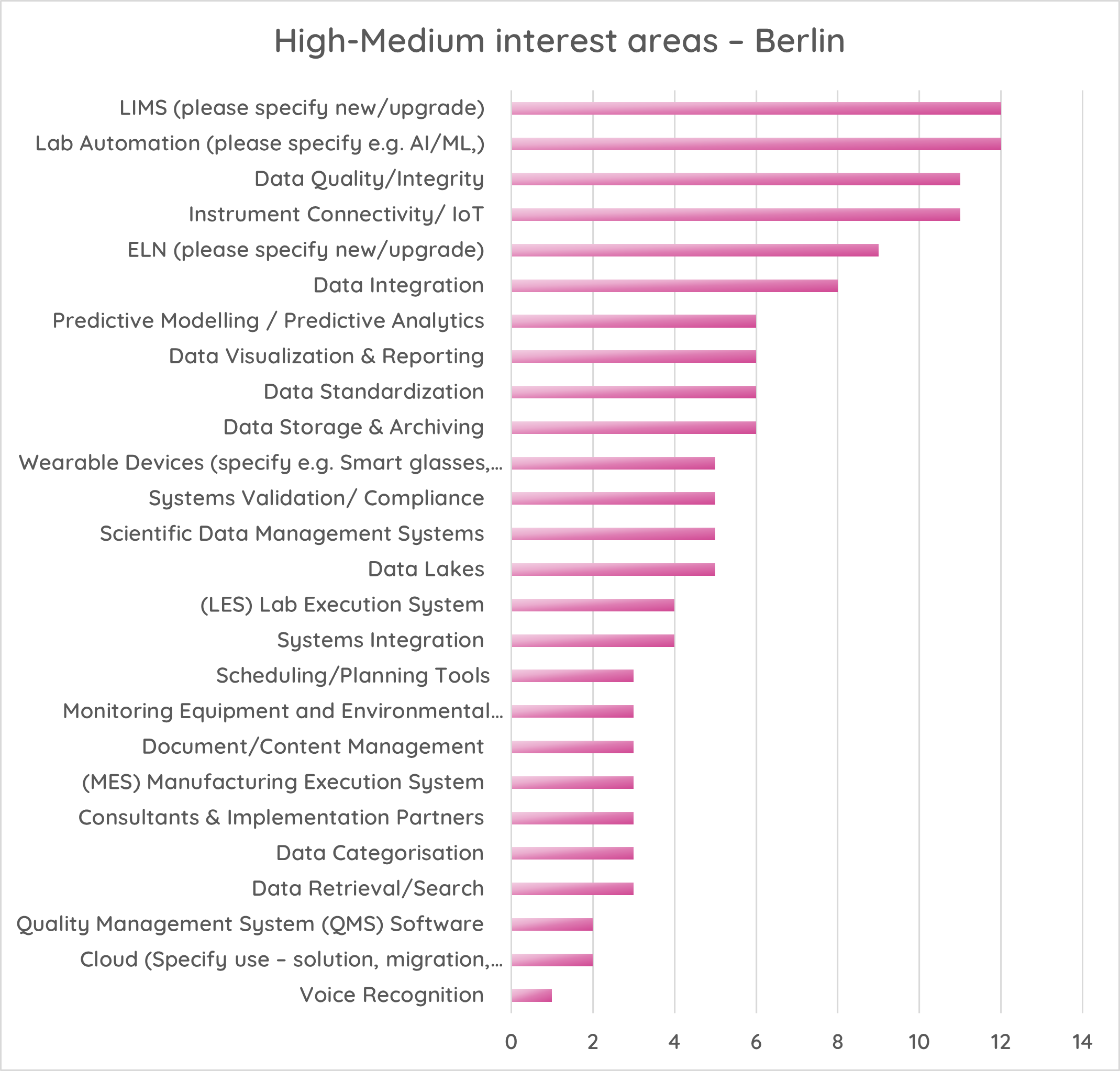
The subjects identified as highest interest to the delegates were:

  • Lab automation
  • LIMS
  • Instrument connectivity
  • Data quality and integrity

Attendees were keen to learn more about data trends for the lab, especially:

  • Data integration
  • Data storage and archiving
  • Data standardization
  • Data visualization and reporting

A graph to show the high-medium interest areas of attendees who were surveyed at SmartLab Berlin 2022

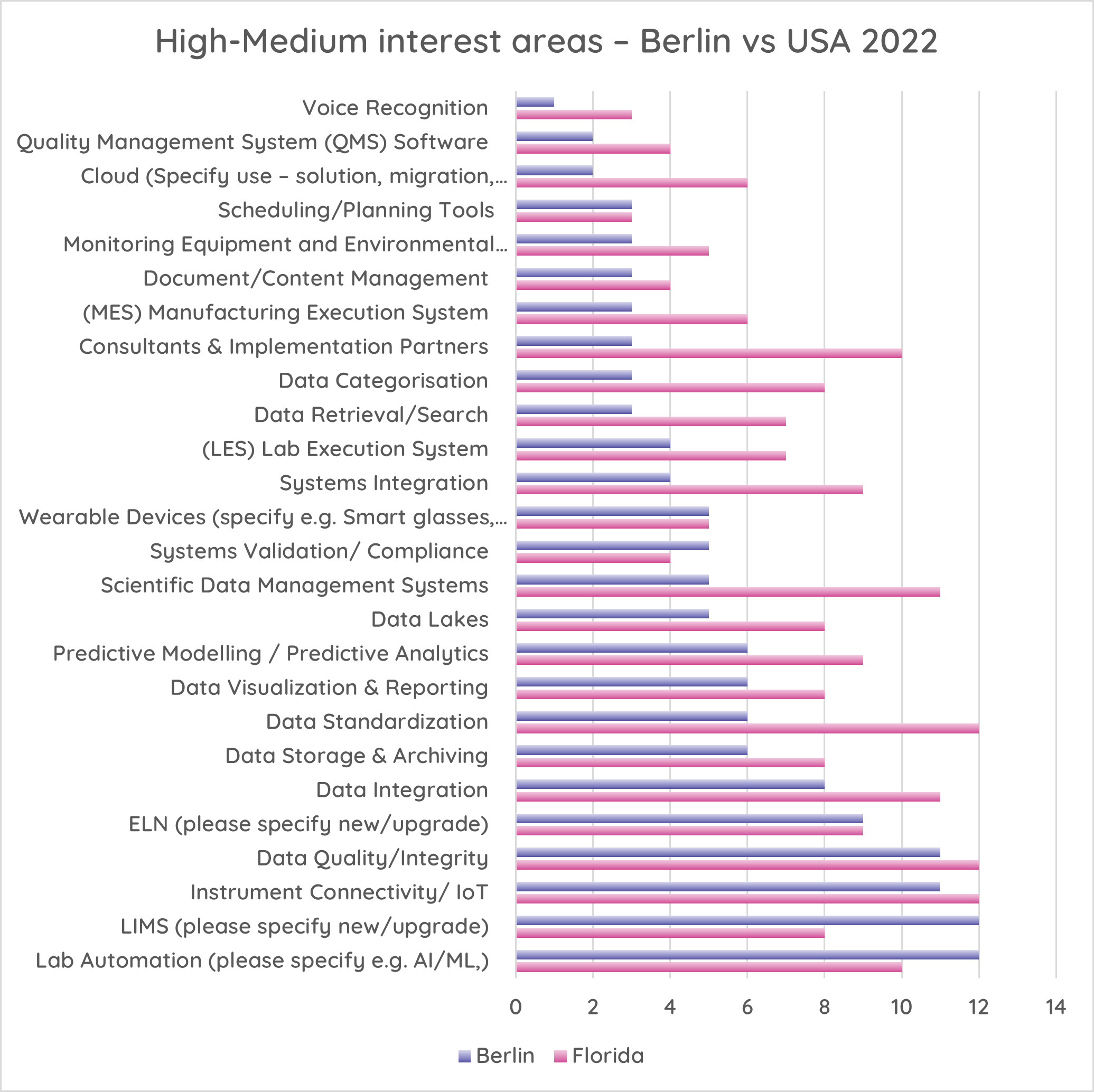
Comparison of priorities for the modern lab identified at USA and EU SmartLab

There were distinct differences in what attendees identified as priorities in North America earlier in 2022, and in Europe in mid-2022. Geoff explains: “We took the trouble of polling two audiences, one at each event, and when Scimcon mapped out the priorities, they are different according to geography. More of the people we spoke with in Berlin mentioned digitization and paperless lab, and what we found was that the Berlin attendees have more specific priorities related to digitization of their labs, so the big-picture focus was more precise: how to automate, how to connect and improve throughput and accuracy, and the tools to underpin this. Unsurprisingly, LIMS was the biggest focus identified in our poll in Berlin, as despite being a decades-old technology, it is at the heart of how labs can remove unnecessary processes and automate their sample workflow more easily. This could be down to the fact that more of the European attendees we spoke to were more manufacturing-focused, whilst the US attendees at the Florida event were more R&D oriented.”

He continues “Earlier this year, on the other hand, we found Florida attendees to be more interested in the data and how to manage it, and in the support they could access from industry consultants who work with market leaders and aide projects in this area. In the big picture, it is interesting to map both geographies against each other, to see what the lab informatics industry is most worried about and sees as challenges to overcome in 2022 and beyond.”

A graph to show the difference in interest areas between attendees at the Berlin and Florida event

Geoff summarizes “As lab informatics consultants with a global customer base in pharma and biopharma labs, it is important to us to check in with influential decision-makers from the lab, to check the services we provide are matching their needs. SmartLab Exchange in Berlin provided us as sponsors with the useful face-to-face opportunity to poll the attendees and gain insight from trends that will impact the modern lab decision-maker. Scimcon partners with customers globally, and this type of clarity into the market needs is invaluable.”

To make 2022 the year you overcome your lab informatics challenges, contact us today.

We’re hiring! Scimcon launches its first Graduate Consultant Scheme for scientific and technology graduates?

Over the past year we have seen a vast increase in demand for quality individuals to lead and resource laboratory digital transformation projects. 

This increased demand coupled with a desire to develop the next generation of world class consultants has resulted in Scimcon creating its first Graduate Consultant Scheme, for scientific and technology graduates.

The role of a Graduate Consultant at Scimcon

Scimcon is actively partnering with universities and attending graduate recruitment fairs to attract and recruit the right candidates to join the scheme. The candidates will be trained in the multiple disciplines that Scimcon typically work, Project Leadership, Business Analysis, Solutions Architecture and Computer Systems Validation. Additionally, they will also get exposure to a domain that combines both science and technology. From the chemistry of materials science to biologics drug discovery, our teams work in a diverse range of scientific fields.

Scimcon will introduce the successful candidates to a career as a laboratory information systems consultant. Training will be provided in a variety of project settings in multiple industries and with various software vendors. The individuals will shadow our experienced consultants to build knowledge and gain an effective understanding of what it takes to provide insightful, pragmatic and highly valued consultancy services to laboratory-based organizations. Our graduate consultants will work on exciting projects for globally recognized industry names giving them the perfect opportunity to kick start their career. As our customers are based around the globe, there is also an exciting opportunity for successful candidates to travel and work on-site with customers in Europe, the US, and beyond.

Who we’re looking for: are you the right candidate?

As customer-facing consultants, our team demonstrate a particular set of qualities. They are dynamic, enthusiastic, driven, conscientious with an eye for detail. They have excellent relationship building skills, but above all they demonstrate integrity consistently. We are looking for individuals that exhibit these same qualities.

If you are graduating in 2022 with a scientific or computer/technology related degree/masters/PhD and you are looking for an exciting career in informatics consultancy, please get in touch with Scimcon’s Head of Operation, David Sanders at dsanders@scimcon.com

Scimcon sponsors SmartLab Exchange and identifies priority themes for 2022 lab informatics?

The SmartLab Exchange, from April 26-27, 2022 at the InterContinental At Doral Miami – Doral, FL is one of the global meetings for lab informatics leaders. Scimcon continues its proud sponsorship of this event, and attended in person to facilitate one-to-one meetings with a number of informatics customers from big pharma and lab-centric sectors. Scimcon sponsors the SmartLab Exchange because it provided a useful access to the community of senior R&D, Quality Assurance and Quality Control decision-makers from industry in North America.

Speakers at the 2022 SmartLab Exchange included the best of the best, with attendees from Proctor & Gamble, Biovia, Bayer, AstraZeneca, Sanofi and Amgen, among others. SmartLab Exchange is attended by invite-only decision-makers. The unique invite-only format of the event means that both sponsors, speakers and delegates can access a closed community that meets their individual needs. 

Feedback and Voice of the Industry

Attending from Scimcon were Geoff Parker and Dave Sanders, and during the event they took the opportunity to poll the customers and contacts from many of the attending organizations, to identify the current 2022 trends in the lab informatics industry. SmartLab Exchange represents the lab informatics community across industries including:

  • Pharmaceutical
  • Bio-pharmaceutical
  • Biotech
  • Biobanking
  • Medical device
  • Petrochemical
  • Bio-fuel
  • Chemicals 
  • Cosmetics
  • Food & beverage
  • Defence
  • Forensics
  • Water
  • Environmental
  • Agriculture
  • Consumer Goods

Geoff and Dave spoke with representatives from a multitude of organizations to take a pulse of the trends in the industry. Geoff explains:

“Scimcon works globally as a lab informatics consultant and implementation partner, with big pharma and biotech companies as well as vaccine manufacturers. We tend to see similar challenges from lab to lab, from organization to organization, and it is useful to take events like SmartLab Exchange as a means of checking in and ensuring that our customers’ needs are current.”

Summary of trends in lab informatics for the modern lab

In the informal poll of attendees at SmartLab Exchange, Scimcon was able to identify key trends and themes that are important to the modern lab in 2022.     

The subjects identified as highest interest to the delegates were:

  • Data standardization
  • Data Quality and Integrity
  • Instrument Connectivity/ IoT 

Interest in product areas for the lab was high, especially for:

  • Scientific Data Management Systems,
  • Lab Automation
  • ELN
  • LIMS

There was a general trend for interest and support in data integration and systems integration.

Scimcon sponsors SmartLab Exchange 2022, summarizes trends from laboratory informatics leaders

Geoff summarizes “As lab informatics consultants with a global customer base in pharma and biopharma labs, it is important to us to check in with influential decision-makers from the lab. SmartLab Exchange gave us a useful ability to poll the attendees and see trends that will impact the modern lab decision-maker, and will help us at Scimcon to hone the way we partner with our customers.”


Scimcon is proud to sponsor SmartLab Exchange, and support customers in life sciences with their lab informatics management and strategy. For more information about Scimcon’s services, contact us today.

What can we expect from Lab of the Future??

With the March congress on the horizon, we take a look at some of the trends within the industry over the last year, and what to expect from the March event.

The increasingly digital laboratory

It’s not a surprise that, with the impact of the pandemic, the importance of digitisation has been heavily reinforced. In early 2020, we reflected on Scimcon’s experience of providing remote support to clients and some of the changes we witnessed as a result of the COVID-19 pandemic, and now almost two years on, we’re seeing a new way of working across labs and organisations.

With digital transformation hot on the global agenda, what’s next for analytical and clinical laboratories? What will the lab of the future look like? Lab of the Future’s March congress aims to answer that question.

What will Lab of the Future deliver?

With a selection of activities scheduled across the 2-day event, there is no shortage of opportunity for attendees to get involved – whether that’s in-person in the Boston, MA event, or from the comfort of their own workspace via virtual attendance.

The agenda features a range of roundtables and presentations, including plenary sessions, as well as more focussed discussions on specific topics, from the digital lab to the connected innovation lab. The tradeshow will also feature plenty of networking session throughout, allowing individuals to form valuable new connections and learn more about some of the key players and innovation across the industry.

The event also welcomes a wide of speakers presenting and hosting discussions during the 2-day period. With confirmed speakers from GSK, Merck, Pfizer, Boehringer Ingelheim, and Astrazeneca, amongst many others, it’s guaranteed to be an event filled with interesting discussions from some of the organisations that have become household names over the last 24 months.

In addition to discussions, the event is also hosting technology showcases, for leading solution providers to demonstrate some of the latest and most disruptive innovation that they’ve been perfecting behind the scenes. Focussed work tracks also allow attendees to take a more in-depth look at some of the latest technologies and trends in 4 key areas – lab automation, digitalisation, connectivity, and innovation.

How Scimcon supports the Lab of the Future

Lab of the Future is an insightful event, and one that we look forward to as well as sponsor each year. The in-person aspect of the event will make for a refreshing change following the pandemic restrictions experienced worldwide, but the additional virtual element of the tradeshow means that users around the globe can participate and get involved, regardless of restrictions and concerns surrounding COVID-19 and travel.

However, in addition to the event, the lab of the future is a concept. Our team at Scimcon has over 20 years of experience in laboratory informatics, and with many of our team members having direct lab experience, we can help you get your digitisation and laboratory informatics project off the ground, whilst understanding the questions and concerns faced by scientists every day.

Scimcon is proud to be sponsoring the Lab of the Future March congress, taking place both virtually and in-person at Hilton Back Bay, Boston, MA on 22nd-23rd March 2022. To organise a meeting and to learn more about how Scimcon can take your lab to the future, contact us today.

 The Lab of the Future is a concept that we have discussed at length during our time in supporting life science organisations around the globe, and that is gaining significant traction with the growth in digital transformation of the lab. So it was an easy decision that when we came across Open Pharma Research’s bi-annual event – Lab of the Future – that we had to get involved.

With the March congress on the horizon, we take a look at some of the trends within the industry over the last year, and what to expect from the March event.

The increasingly digital laboratory

It’s not a surprise that, with the impact of the pandemic, the importance of digitisation has been heavily reinforced. In early 2020, we reflected on Scimcon’s experience of providing remote support to clients and some of the changes we witnessed as a result of the COVID-19 pandemic, and now almost two years on, we’re seeing a new way of working across labs and organisations.

With digital transformation hot on the global agenda, what’s next for analytical and clinical laboratories? What will the lab of the future look like? Lab of the Future’s March congress aims to answer that question.

What will Lab of the Future deliver?

With a selection of activities scheduled across the 2-day event, there is no shortage of opportunity for attendees to get involved – whether that’s in-person in the Boston, MA event, or from the comfort of their own workspace via virtual attendance.

The agenda features a range of roundtables and presentations, including plenary sessions, as well as more focussed discussions on specific topics, from the digital lab to the connected innovation lab. The tradeshow will also feature plenty of networking session throughout, allowing individuals to form valuable new connections and learn more about some of the key players and innovation across the industry.

The event also welcomes a wide of speakers presenting and hosting discussions during the 2-day period. With confirmed speakers from GSK, Merck, Pfizer, Boehringer Ingelheim, and Astrazeneca, amongst many others, it’s guaranteed to be an event filled with interesting discussions from some of the organisations that have become household names over the last 24 months.

In addition to discussions, the event is also hosting technology showcases, for leading solution providers to demonstrate some of the latest and most disruptive innovation that they’ve been perfecting behind the scenes. Focussed work tracks also allow attendees to take a more in-depth look at some of the latest technologies and trends in 4 key areas – lab automation, digitalisation, connectivity, and innovation.

How Scimcon supports the Lab of the Future

Lab of the Future is an insightful event, and one that we look forward to as well as sponsor each year. The in-person aspect of the event will make for a refreshing change following the pandemic restrictions experienced worldwide, but the additional virtual element of the tradeshow means that users around the globe can participate and get involved, regardless of restrictions and concerns surrounding COVID-19 and travel.

However, in addition to the event, the lab of the future is a concept. Our team at Scimcon has over 20 years of experience in laboratory informatics, and with many of our team members having direct lab experience, we can help you get your digitisation and laboratory informatics project off the ground, whilst understanding the questions and concerns faced by scientists every day.

Scimcon is proud to be sponsoring the Lab of the Future March congress, taking place both virtually and in-person at Hilton Back Bay, Boston, MA on 22nd-23rd March 2022. To organise a meeting and to learn more about how Scimcon can take your lab to the future, contact us today.

Meet Scimcon: Jon Fielding?

Profile

What do you enjoy the most about working at Scimcon?

I didn’t really fit into the company I was in before, so firstly, I think to enjoy any role the people you work with are important. Realistically, I probably spend more time speaking with my colleagues than I do my own wife and kids, so having great colleagues definitely makes Scimcon enjoyable.

Secondly, the challenges within the role are exciting. Whenever you start a new contract – as we do regularly, supporting clients in pharma and biopharma – there is either an implementation project that needs carrying out, or an issue that needs resolving. Sometimes, the task at hand is not something I am directly familiar with or have the exact experience doing, but that makes it a challenge. And it’s the challenge that I enjoy.

In my prior role, we partnered with Scimcon on a number of projects. I had been involved in building a platform for our mutual client and when they needed to take the project forward, they needed someone to train, support, and project manage the implementation of the project software. It seemed a no-brainer for me to join the consultancy team at Scimcon, and to continue to support the project and the client to help them to progress. The transition into Scimcon was seamless, and I later moved from that initial project within the vaccines space onto a biotech company in the Netherlands, whom I have been supporting on e-systems.    

My background helps me to bring people and team skills into play, so I am very suited to the Scimcon way of working, to support clients and to manage processes, SOPs, digital, and software projects for scientific companies. The client I am supporting currently was initially reluctant to appoint a lab informatics consultancy that was not local, and questions were raised as to whether or not we could perform the role from the UK without impacting the level of support we provide. As a test run, we were initially only working on a 3-month contract. Their processes are crucial to the business scale-up and growth, and our experience with other big pharma organisations has come into play helping them to navigate the decisions needed. I think we successfully demonstrated to them that it is feasible to be productive offering great support from the UK – so much so that the original 3-month project is now 30 months.

What do you enjoy doing in your spare time?

Every child has a hobby growing up, and of course in England, playing sports is probably one of the most popular activities. For me, football was my favourite pastime which evolved into more than just a hobby. It actually paved a pathway for all areas of my life.

What started out as a recreational game became a profession, as I left school at 16 to become a full-time football player, At 20, when my professional playing career finished, football again opened a window of opportunity to move to Southern California and coach football for 3 months. I returned 12 years later!

At 27, football again paid for my University education at Point Loma Nazarene University in San Diego, where I was sponsored via a soccer scholarship to study Business and Finance. I had never even enjoyed school, never mind imagined studying at University, but football provided a unique opportunity that was too good to refuse.

During my senior year at University, while coaching football in Denver during the summer, I was introduced to my fiancé Sarah who had also – coincidentally – attended University in the USA on a football scholarship. She was almost in a parallel to me, only she was based in Florida while I was on the total opposite side of the country in California.

Sarah and I had our first child then returned to the UK shortly after, where we now have four sons – aged 10, 7, 5, and 1. Our 10 and 7-year-olds are, like their mum and dad, football-mad, so we spend our weekends travelling to watch them play. Our 5-year-old is starting to get the bug, and we are yet to see if football is something our youngest warms to, but I can’t see the apple falling too far from the tree.

I still spend every day at some sort of football activity. Both our older boys are at the football academies so they each have 3-4 days a week training and playing. Football remains our outside-of-work life, having brought us together all those years ago.   

And with the skills I learned at university, studying business and finance, as well as the team skills associated with playing sport, I am well placed to bring team leadership to the Scimcon family, and to focus on the best tactics and teams to work on a winning side.

What is your favourite travel destination?

Southern California was my home for 12 years, and having attended University in San Diego, that would be my obvious choice. We have a lot of friends and happy memories there, and we love the area – and the food!

2020/21 has been an interesting couple of years – how has it impacted you outside of work?

We made the decision to return to UK as a family when we had the boys, for the support network of close family and friends. As I have been working from home for so many years anyway, personally my life hardly changed. However, it was a terrible impact for the boys. For any young kids, that transitional age and loss of companionship has been a huge negative experience. Luckily, the boys are pretty resilient and seemed to have bounced back into the new normal without any issues.

Scimcon as a business is deeply rooted in technology – but how technology-oriented are you? What devices do you use?

Funnily enough, I am not really a techie! I use a PC and a phone, but not much else.

Does your use of technology differ outside of work?

Even though I don’t spend a great deal of time on gadgets and gizmos, I love the knowledge and benefits you can see from technology. For example, having spent so many of my formative years playing and coaching football, I am now still involved with my sons and their training and I see the technology to hand, which was never available when I was playing in the US. It’s absolutely fascinating, and there’s two pieces of tech in particular that I’m seeing used regularly at my sons’ training and matches. One is a Veo sports camera, which follows the ball and records the play, the other is an APEX GPS tag. This handy piece of kit is worn in the back of my son’s shirt when he’s playing, and all the data collected throughout the match is recorded on a smartphone, recording metrics such as speed, average position, and provides an overall performance review.

It’s amazing to see two of my previously completely separate worlds – football and technology – coming together, and it is really interesting to see how this technology is enabling football. As a coach, it also allows me to see and read the data available, so that we can then determine what is needed to improve in a game.

Scimcon is not a technology company, it is a people company that helps to solve the technology challenges for our clients, whether they be implementation, process or project-related. I am happy that I am not a techie, but very much a team and a people-person who can always learn and bring new skills to the table.

In order to work as intended, this site stores cookies on your device. Accepting improves our site and provides you with personalized service.
Click here to learn more